London start-up Sequent has raised $2.2m in pre-seed funding to take Alan, its AI-assisted formal verification platform, out of early access. The pitch is simple and refreshingly sceptical of AI: let the model hunt for mathematical proofs, but never let it be the judge.
What happened
Sequent announced on 25 November 2026 that it had closed a $2.2m (around £1.7m) pre-seed round, co-led by Frachtis and Metaplanet Holdings, the investment firm of Skype co-founder Jaan Tallinn. Tallinn also led Anthropic’s 2021 Series A, BusinessCloud notes.
The company was set up in London in January 2026 by chief executive Charles Cooper and chief technology officer Ramana Kumar. Cooper leads development of Vyper, one of the two main languages used to write Ethereum smart contracts. Kumar is a former AI safety researcher at Google DeepMind and co-created CakeML, a compiler proved correct down to the machine instructions it emits.
The money will take Alan to full launch and fund AI compute and engineering, sales and marketing hires. Published pricing starts at $99 a month for individuals, $200 a month for auditors and from $500 a month for teams. Curve Finance, a decentralised exchange, is the first paying customer.
The company’s origin story is unusually candid. In 2021 Cooper accidentally introduced a flaw into the Vyper compiler. Deployed contracts could not be updated. In July 2023 attackers used the bug against older Curve pools and other projects, taking more than $50m, according to SiliconANGLE. Kumar then offered to help prove the compiler correct, and Sequent grew out of that work.
How it works
Testing only checks the cases somebody thought to write down. Formal verification states a property the code must always satisfy, then proves it holds in every case the proof covers. Writing proofs by hand needs scarce specialists and months of work, so the technique has stayed in niches such as compilers and safety-critical systems.
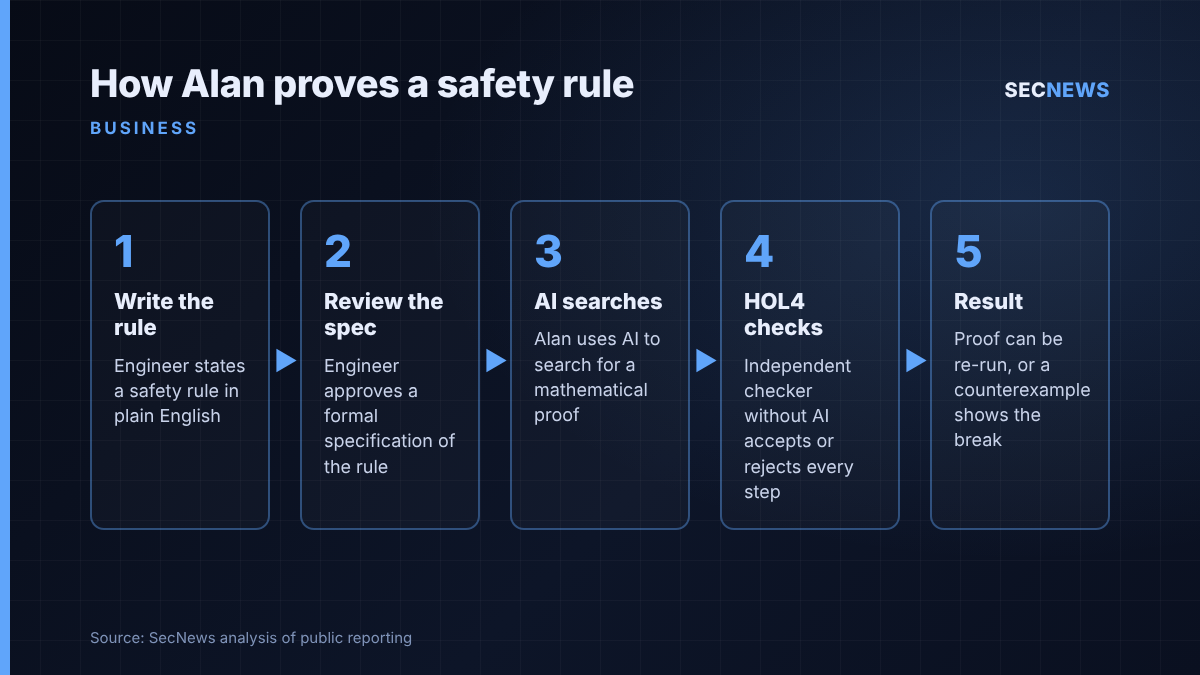
Alan tries to make that work cheap. An engineer writes a rule in plain English, such as “no user can withdraw more than their balance”. The rule is turned into a formal specification, which the engineer approves, and AI then searches for a proof. That approval matters, because a proof is only as useful as the property it proves.
The key design choice is what happens next. Every proof Alan produces has to pass HOL4, an independent proof checker that uses no AI and that Kumar has helped develop for more than a decade. If the checker rejects a step, the proof fails, however convincing the model’s explanation sounds. When a rule turns out not to hold, Alan shows how the code breaks it.
For Curve, Alan was used on two-coin StableSwap pools holding standard tokens. It showed that depositors cannot lose more than a defined cap to any single user, regardless of actions they take and in whatever order. It also found minor rounding and accounting errors, none breaching the limit, and the proof can be re-run independently. Curve chief executive Michael Egorov drew the contrast with conventional review: “Audits tell us what reviewers found.”
Alan supports only Vyper contracts at the moment. Solidity and Solana support is in development, with general software in Rust, C, TypeScript and Python to follow. The founders’ next big job is verifying the Vyper compiler itself: the Curve work covers the pool contracts, while the 2021 bug lived in the compiler that builds them.
Why it matters for UK organisations
A $2.2m pre-seed round is small. It still says something about where UK security investment is heading. Much of the AI security money this year appears to have gone into agents that find, triage or explain vulnerabilities. Sequent bets that as AI writes more code, review must produce evidence, not opinions. Rauno Miljand, managing partner at Metaplanet, put it bluntly, telling BusinessCloud that asking another AI to mark its own homework “is no answer”.
Crypto is a practical starting point, not the destination: smart contracts hold money and are hard to patch. The more interesting market for UK buyers is the planned move into Rust, C, TypeScript and Python. Those are the languages behind payment platforms, identity services, embedded devices and the software that suppliers to critical national infrastructure deliver.
Cooper’s wider argument should worry anyone who relies on keeping code private. He told SiliconANGLE that banks, governments and companies running older systems have long relied on that secrecy, and that AI-powered attacks are wearing the protection away. If attackers can analyse code cheaply, proving the properties that matter beats hoping nobody looks.
There is a regulatory angle too. Secure-by-design expectations from the NCSC, government software security guidance and the supply chain duties in the Cyber Security and Resilience Bill all push buyers to ask suppliers for evidence, not just assurances. A reproducible proof is stronger evidence than an audit letter, provided the buyer knows what it covers.
Expert view
In my experience, the most damaging bugs we find in testing are rarely clever. They are broken business rules: a refund that can be claimed twice, a transfer limit enforced in one code path but not another, a rounding error that can be repeated at scale. These are exactly the properties Alan is built to state and prove.
What I like most is the architecture. A great deal of AI security tooling asks you to trust the model’s judgement. Here the model’s confidence does not matter, because a hallucinated proof is just a failed proof.
The caveats are real, though. A proof says nothing about properties nobody wrote down, about compromised keys or dishonest data feeds, or about flaws in the compiler and runtime unless those are proved as well. The Curve case shows this clearly: the pool’s code was proved, but the compiler that caused the original loss is still work in progress. Treat formal verification as an addition to testing, not a replacement.
Commercially, the question is whether teams will pay to re-run proofs on every code change. If they do, the market is far bigger than smart contract audits.
What to do now
- Write down your invariants. For payment, entitlement and access control logic, list the rules that must never be broken, in plain English. This supports Cyber Essentials user access control thinking whatever tools you buy.
- Ask suppliers what kind of evidence they hold. In procurement and third-party risk reviews, ask whether critical components are covered by tests, audits, formal proofs or nothing.
- Pilot on a small, high-value component. Start with one well-defined module, such as a limits engine.
- Keep testing. Proofs do not replace penetration testing, dependency management or security update management. Keep Cyber Essentials patching discipline.
- Treat AI-generated code as untrusted. Whatever tools you use, require independent checks before AI-written code reaches production.
Bottom line
Sequent is a small London round with a big idea behind it: use AI to make mathematical proof affordable, and let a separate checker that uses no AI decide what counts. It is early, it is focused on crypto for now, and a proof only covers what was specified. UK buyers should still watch closely. As AI speeds up both code writing and code attacking, verifiable evidence is likely to matter more than another reviewer’s opinion.