A researcher has published a working chain that takes an anonymous guest session on Cacti 1.2.31 all the way to command execution on the monitoring server. As of Friday 27 November there is no CVE, no fix and no vendor advisory, so the only defence is configuration.
What happened
On 26 November 2026 a researcher using the handle ek0ms savi0r published proof-of-concept research against Cacti, the open source network monitoring and graphing platform found in many network operations centres. The chain, tracked under the names 4HTTP2SHELL and 4HTTP2ROOT, needs only four HTTP requests and no credentials, provided the Cacti guest account has been switched on.
The affected build is Cacti Core 1.2.31, the current release. The researcher describes the path as going from a brand new unauthenticated session to running commands as the Cacti server user, with no login, API key or phishing involved. watchTowr, which published an FAQ on the issue on the evening of 26 November, confirms the version and conditions, lists the vendor patch as pending and says no exploitation in the wild had been reported as of 27 November. The bug is not in the CISA Known Exploited Vulnerabilities catalogue.
I checked the project’s public channels this morning. The Cacti GitHub releases page still shows 1.2.31, published in June, as the latest version, and the project’s security advisories list has nothing dated November and nothing relating to guest profile settings. No CVE identifier has been assigned.
The technical picture
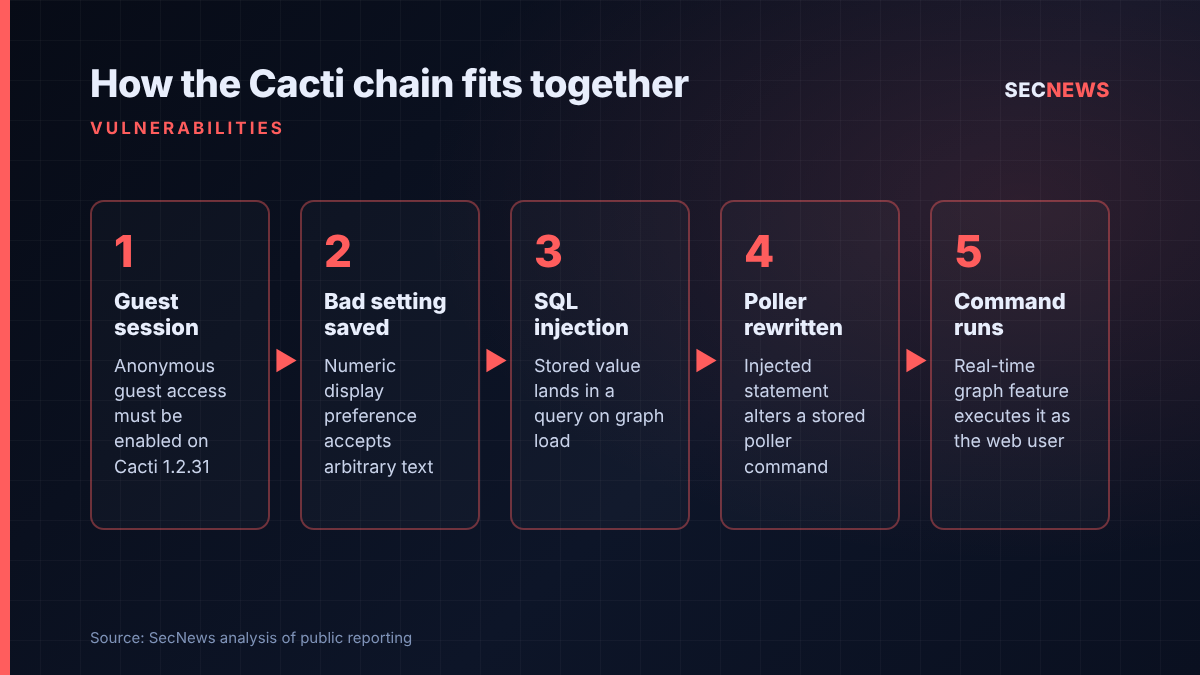
The broad shape matters because it shows which controls break it. Four weaknesses combine, none catastrophic alone.
- Weak input typing. A guest can save a personal display preference that is meant to be a number, and Cacti accepts arbitrary text in its place.
- Trusted stored values. Because the value is read back later as a stored default rather than as fresh request input, it skips the validation applied to normal parameters.
- Second-order SQL injection. When a graph page loads, that stored text is concatenated into a query, and, in the researcher’s testing, the database driver processed more than one statement. That lets the attacker alter data elsewhere in the database.
- Commands stored in data. The attacker uses that access to change a poller entry, and a real-time graphing feature reachable by the same guest session then hands the stored value to the operating system.
The result is code execution as whichever user the web server and poller run under. watchTowr notes that is usually a low-privileged web user rather than root, but on a monitoring box that distinction is less comforting than it sounds. RavenAI’s write-up notes the chain also needs graph and poller identifiers that are valid for the target installation.
There is an important brake on all this: Cacti has shipped with the guest account disabled by default since version 0.8.7. The exposed population is therefore installations where someone deliberately turned guest viewing on, typically to put dashboards on a wall screen or share bandwidth graphs without handing out logins.
Why it matters for UK organisations
Cacti is the sort of tool that rarely appears on an asset register but is everywhere once you look. UK internet service providers, hosting firms, universities, local authorities and managed service providers have used it for years to graph router, switch and server performance over SNMP.
The real prize is not the monitoring server but what it knows. As watchTowr puts it, a foothold on Cacti can reach “far beyond the monitoring server itself”, because the platform holds SNMP community strings, device logins and connection details for large parts of the estate. An attacker who controls the poller can also quietly tamper with what operations staff see, suppressing the very graphs and alerts that might reveal their activity.
For managed service providers the risk compounds. A single Cacti instance polling many customer networks is a natural pivot into all of them, which is exactly the supplier route the Cyber Security and Resilience Bill is trying to bring into scope for MSPs. The project also has form: in June it published three critical advisories for flaws reachable without logging in, two of them in the same graph viewing page, so this is not a component that should ever have faced the internet.
Expert view
When we test internal networks, monitoring platforms are among the first things we go looking for, and Cacti in particular has a long track record of injection bugs. It is attractive for the same reason it is useful: it talks to everything. In my experience the guest account is turned on far more often than people admit, usually by an engineer years ago who wanted a NOC screen to work without a login, and it then becomes invisible.
The design lesson here is one I see repeatedly in code reviews. Data that has been written to the database is treated as trusted when it is read back, even though a user supplied it. Add a component that executes commands built from database values and any injection anywhere becomes remote code execution. Cacti’s maintainers will no doubt tighten the integer validation, but the deeper fix is to stop storing shell commands in tables that an injection can reach.
Two caveats: there is no confirmed exploitation yet, and only installations with guest access enabled are exposed. But a public, four-request chain against an unpatched product is the kind of thing that gets folded into mass scanning quickly, and attackers have often moved within days of publication. I would not plan on having a week.
What to do now
- Find every Cacti instance. Check the asset register, scan internal ranges and ask network teams and MSPs directly.
- Disable the guest account. In Cacti’s user administration, turn off guest access. This removes the entry point and is the single most effective step until a fix ships. It maps directly to the Cyber Essentials secure configuration control: remove or disable accounts that are not needed.
- Take it off the internet. The web interface should only be reachable from management networks or via VPN, in line with the Cyber Essentials firewalls control. If you need a public dashboard, publish static images rather than exposing the application.
- Look for signs of tampering. watchTowr advises reviewing poller configuration for unexpected command values, checking logs for warnings about non-numeric display settings and looking for new files created by the poller process.
- Rotate what Cacti knows. If any instance had guest access enabled and was reachable from untrusted networks, assume the SNMP strings and device credentials it holds may be exposed and change them. Move to SNMPv3 where devices support it.
- Patch when the fix lands. Watch the Cacti releases and security advisories pages and apply the update promptly once it appears, which is the Cyber Essentials security update management control in practice.
Bottom line
This zero-day depends on configuration and nobody has been seen using it yet. But it is public, simple and unpatched, and it targets a box that holds the keys to your network. Turn off guest access, pull Cacti off any untrusted network today and treat its stored credentials as sensitive secrets rather than plumbing.