New Group-IB research shows Telegram recruitment adverts linked to a self-described Iranian intelligence service turned up in London, Birmingham and UK-wide job and accommodation groups. Two in five of the posts never mentioned Iran at all, and that is the part UK security teams should worry about.
What happened
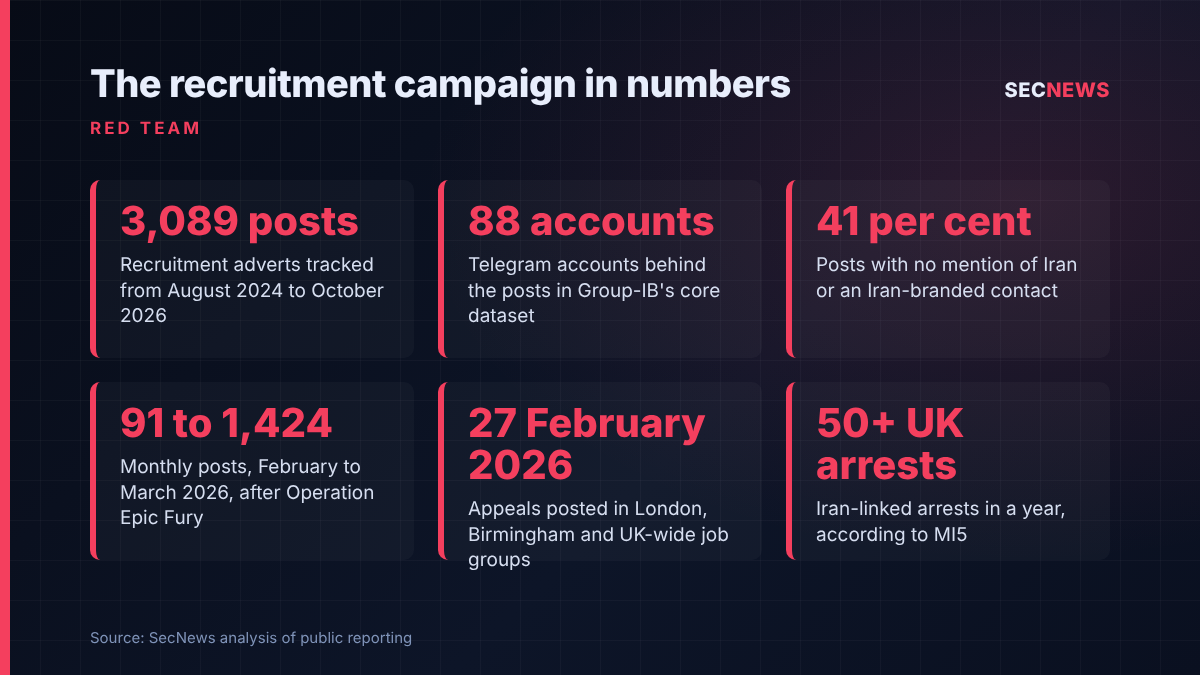
On 26 November 2026, Group-IB published an analysis of 3,089 recruitment posts made by 88 Telegram accounts between August 2024 and late October 2026. The adverts offered money for tasks ranging from filming local places and “inspecting” sites up to criminal acts, arson included. They appeared in communities serving Israel, the Gulf states, the United States and the UK.
The UK detail is specific. According to Group-IB, English-language appeals were posted on 27 February 2026 into JOBS LONDON, Jobs in Birmingham and two national jobs-and-accommodation groups. They framed working with Iran as a response to the news and steered readers towards VIPEmployment, a recruitment bot that has been the public face of the activity since 2024. A reworded version appeared in another UK accommodation and jobs group on 4 March, and the same English text surfaced in a Polish jobs group.
Attribution needs care. Group-IB states plainly that it has not attributed these campaigns to any state. Some of the accounts claim to speak for an “Iranian Intelligence Service”, but that is their own branding. The link to Tehran comes from elsewhere. Earlier this year, Recorded Future’s Insikt Group assessed VIPEmployment as likely to be a persona of Iran’s Ministry of Intelligence and Security (MOIS), based on cross-promotion with Handala Hack Team, which Insikt and others tie to MOIS. Insikt also recorded VIPEmployment widening its reach after the US launched Operation Epic Fury in February, posting into job groups for Europe, student chats and political channels in English-speaking countries.
How it works
The interesting finding is that the same accounts pushing openly branded intelligence appeals were also running ordinary-looking job adverts. Group-IB counted 1,271 posts, roughly 41 per cent of its core dataset, with no reference to Iran and no Iran-branded contact. One channel impersonated SWCA Environmental Consultants, a genuine US firm, offering rewards for pollution reports and site inspections. Group-IB found no sign the real company was involved; its branding was apparently borrowed without consent.
Volume tracked geopolitics closely. Monthly posts climbed from 91 in February 2026 to 1,424 the following month, nearly sixteen times higher, after Operation Epic Fury began on 28 February. Despite a second peak in June, public activity fell to double figures a month by August, though some lures were still live in early November.
The operation also looked industrialised. Group-IB saw scheduled posting, identical adverts fired into dozens of groups within seconds, and accounts that switched between overt intelligence appeals and bland job offers within minutes. For three accounts analysed closely, between 68 and 84 per cent of posts followed fixed timers. Recruitment contacts were also slipped into news-style alerts and open-source intelligence feeds: of 673 posts classed as alerts or demoralising content, 476 carried a recruitment contact.
What happens after first contact is largely invisible, because the dataset contains only public posts. Group-IB cites CNN reporting from May in which a handler asked reporters to prove they were in London before offering cryptocurrency for putting up posters. The pattern described by Israeli and Norwegian authorities is small paid “test” tasks first, then gradual escalation, with the threat of exposure used as leverage. Group-IB adds that withheld pay can also be used as leverage.
Why it matters for UK organisations
This sits against a hard UK backdrop. In his October update, MI5 director general Ken McCallum said Iran-linked operations had resulted in over 50 UK arrests in the previous 12 months, and that Iran was showing ambitions to go after harder targets such as military sites. Group-IB links no account in its research to those cases. But the research gives a clear picture of the top of the funnel: low-cost, high-volume adverts placed where people look for work or a room.
For UK organisations, the exposure is less about IT systems and more about people and premises. Any business with sites, staff or contractors that a hostile state might care about, such as defence suppliers, critical national infrastructure, Jewish community organisations, media, or firms linked to Israel or the US, has a reason to care about who is being paid to film its car parks. The adverts were placed in groups used by job seekers, students and people looking for accommodation, the same pool that fills temporary, cleaning, security and logistics roles.
Expert view
When we run physical and social engineering assessments, the hardest control to test is the one that relies on a person spotting that something is wrong. This campaign deliberately removes that cue. A security awareness slide that says “beware of foreign intelligence officers” does nothing for a student answering a vague gig advert for site reports. Group-IB’s own recommendation lands on the right point: judge an offer by what it asks you to do, not by who it says it is.
In my experience, organisations also underestimate how much a hostile actor can learn from cheap, lawful-looking tasks. Photos of entrances, shift change times, delivery bays and badge designs are exactly the reconnaissance a red team gathers in week one. Here it is outsourced to strangers for modest sums, often in cryptocurrency. Defenders should treat the outside of their buildings as an observed surface, and treat repeated filming or loitering as a report-worthy signal rather than an oddity.
The automation matters too. Scheduled posting at scale makes this cheap to restart, so this year’s decline should not be read as the end of it.
What to do now
- Brief staff on behavioural red flags, not actors. Unverifiable employers, vague tasks with outsized pay, requests to film, photograph or “inspect” named locations, and payment in cryptocurrency are the warning signs.
- Tell people it is safe to stop. Make clear that anyone who has already done a first task should cut contact, share nothing further, and report it. Withheld pay is not a reason to continue.
- Give reporting a clear route. Point staff to your security team and to the police, on 101 or 999 in an emergency.
- Harden the physical perimeter. Review CCTV coverage, signage and guarding procedures so repeated photography or surveillance of sensitive sites is noticed and logged.
- Reduce what can be learned cheaply. Check what site photos, floor plans and staff details you publish. It is the Cyber Essentials idea of minimising attack surface, applied to buildings.
- Vet the vetting. For roles with site access, confirm that pre-employment screening and contractor checks follow NPSA guidance.
- Watch for brand abuse. As SWCA found, your name can be borrowed for a fake job channel. Monitor for impersonation of your organisation on messaging platforms.
Bottom line
Group-IB has documented the recruiting layer of a campaign that Recorded Future links to Iranian intelligence, and it reached UK job boards. Group-IB itself makes no state attribution, and the campaign’s real-world impact is unverified. The practical lesson stands either way: the most dangerous adverts are the ones that look like ordinary work, so train people to judge the task, not the label.
Sources
- Group-IB: Odd Jobs: Inside Telegram Recruitment Campaigns
- Recorded Future Insikt Group: Iran’s MOIS and the Handala brand’s physical threat activities
- Cyber Press: Researchers Uncover 3,089 Telegram Recruitment Posts Linked to Espionage and Criminal Activities
- The National: UK intelligence chief warns of ‘major shift’ after Iran attacks military bases