The UK’s financial watchdog, the FCA, has told technology companies that badging an AI agent as a tech product will not keep it outside financial regulation. Regulated firms were also reminded that accountability for agentic AI stays with their senior managers, even when the agent belongs to someone else.
What happened
On Tuesday 24 November 2026 the FCA published a statement on agentic AI aimed at two audiences. The first is the developers and platforms building personal AI agents that can act for consumers. The second is the authorised firms that either deploy agents themselves or will increasingly find customers’ agents knocking on their door.
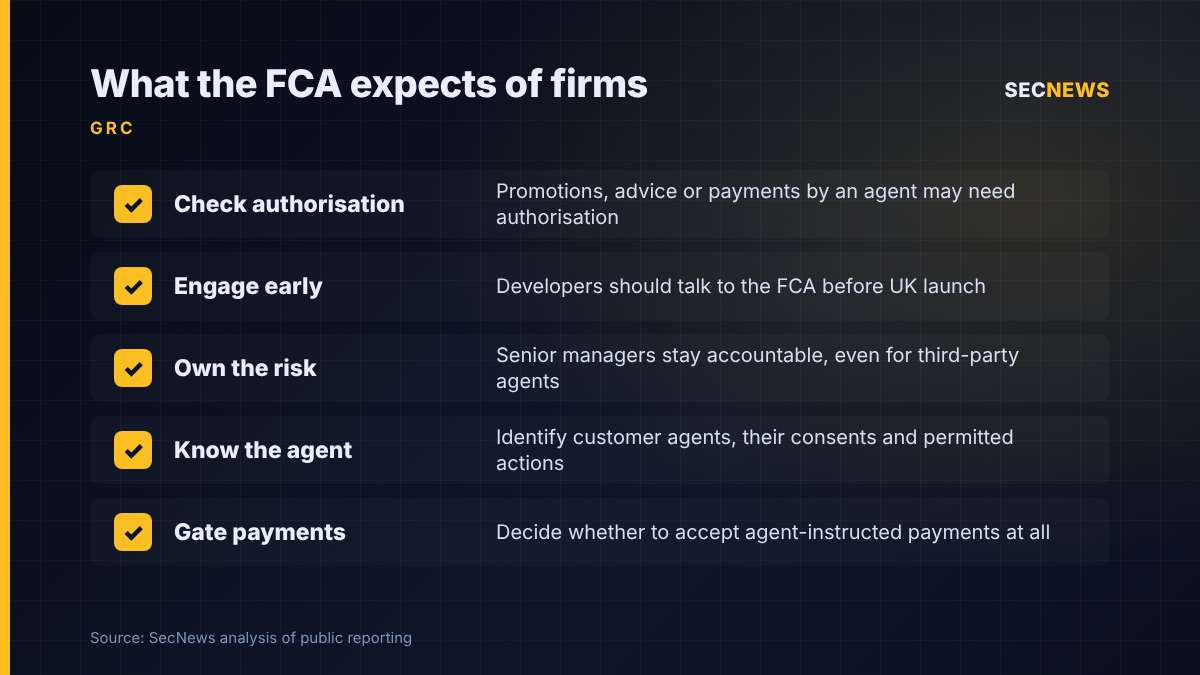
The core message to developers is simple. If an agent’s functions amount to a regulated activity, such as communicating financial promotions, giving advice or providing payment services, then describing the business as a technology provider does not create an exemption. The regulator said it has powers to step in where regulated services are offered without authorisation and that it will use them if needed. It urged developers to talk to it early, so that the rules that apply to their products are understood before launch rather than after.
Reuters reported that the FCA did not name any company, but that the statement landed as Meta launched its Muse personal agent in the UK, a product Meta says can renew car insurance, chase refunds and make online purchases. Meta told Reuters it had engaged constructively with the relevant authorities and would continue to do so.
The detail
For regulated firms, the FCA leaned on rules that already exist rather than inventing new ones. According to Financial Planning Today’s account of the statement, the regulator expects firms using agents to put consumers first, be open with them, keep accountability clear and plan for failure. It pointed to the Consumer Duty, with its requirements to avoid foreseeable harm and to monitor outcomes, and to the Senior Managers and Certification Regime. Senior managers answer for AI models in their area, whether built in-house or bought in, and must grasp the risks, challenge deployment and keep oversight arrangements proportionate.
The section that should interest security teams most deals with the reverse case: customers sending their own agents to interact with a firm. The FCA wants firms to work out how they recognise an agent, which customer consents sit behind it, the limits on its authority, and how the customer is supported if things go wrong. It also asked firms to look at their systems and controls, any liability that arises from acting on an agent’s instructions, and whether it is appropriate to accept a payment instructed by an agent or sent from a digital wallet an agent controls.
Developers were told that model output about money needs clear, consistent disclaimers backed by real safeguards, and the FCA will keep assessing agentic products as they change.
Why it matters for UK organisations
This is a perimeter warning, and perimeter questions are where governance and security meet. Consumers dealing with an unauthorised service have far weaker routes to redress, which is why the regulator is drawing the line before agentic finance becomes routine.
For banks, insurers, lenders and payment firms, the bigger operational shift is that agents will arrive whether or not the firm has a strategy for them. Today most customer-facing controls assume a human at a browser or in an app. An agent with delegated access breaks several of those assumptions at once: it can act at machine speed, across multiple providers, using credentials or tokens a customer may not fully understand they have handed over.
The statement also closes off a tempting argument: using an outside agent provider does not shift compliance responsibility to that vendor. Agentic AI therefore belongs in third-party risk management like any other critical supplier.
Expert view
I think the FCA has framed this well, because the hard problems here are identity and authority, not intelligence. When we test customer-facing platforms, the weak spots are usually the places where the system cannot tell who, or what, is really making a request, and where a valid session is trusted to do far more than it should. An AI agent holding a customer’s session or API token is a textbook example of that risk.
In my experience, most firms cannot yet distinguish agent traffic from automated abuse with any confidence. Years of bot detection were built to block exactly the scripted, high-speed behaviour a legitimate customer agent produces, so deciding which automation to welcome will be a real design challenge.
There is also a prompt-injection dimension that boards should understand in plain terms. An agent that reads emails, web pages or documents can be manipulated by content planted in them. If that agent can also move money or change account details, a regulated firm receiving its instructions has to assume some of those instructions will not reflect what the customer actually wanted. The FCA’s question about whether to accept agent-initiated payments at all is a sensible one, and some firms will reasonably conclude the answer is “not yet” for higher-risk actions.
Finally, the accountability point is the one I would put in front of the executive committee. “The vendor’s model did it” will not be an acceptable answer, and senior managers need to be able to show they understood the risk before they switched anything on.
What to do now
- Inventory agent use and exposure. List where your firm deploys AI agents and where customers’ agents can already reach you through APIs, open banking connections or scraped web journeys. Assign a named senior manager to each.
- Check the regulatory perimeter. If you build or distribute an agent that touches promotions, advice, payments, credit or insurance, take legal advice on authorisation and engage the FCA before UK launch.
- Define agent identity and scope. Prefer delegated, scoped and revocable tokens over shared customer credentials. Limit what an agent can do by default, in line with the Cyber Essentials principle of least-privilege user access control.
- Gate high-risk actions. Require fresh customer confirmation, through a separate channel, for payments to new payees, changes to contact details and product switches initiated by an agent.
- Tune monitoring. Update fraud and bot-detection rules so legitimate agent traffic is identifiable and anomalous agent behaviour is flagged, and log agent actions so disputes can be reconstructed.
- Treat agent vendors as critical suppliers. Add them to third-party risk assessments, contract for incident notification and audit rights, and test the scenario where an agent is compromised or manipulated.
Bottom line
The FCA has not created a new AI rulebook. It has made clear that the existing one already covers agents, and that the label on the box does not change what is inside it. For developers, that means authorisation questions need answering before launch. For regulated firms, it means agent identity, consent and permissions are now a governance issue that senior managers will personally own.