FIFA has confirmed that criminals got into its systems and took some personal and business records, and it is now working with law enforcement. Sources say the attackers did not need a software flaw: they posed as FIFA staff, which should worry every UK organisation that relies on a help desk or a trusted email thread.
What happened
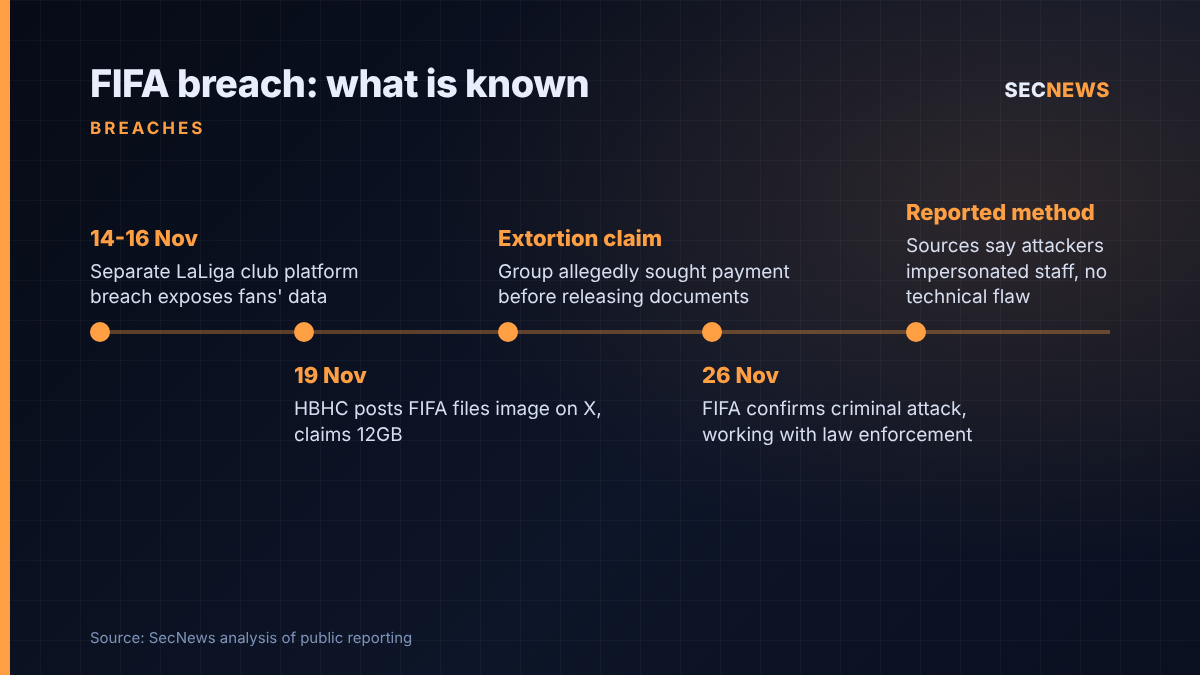
On Thursday 26 November 2026, football’s world governing body confirmed it had been the victim of what it called a criminal cyber attack. A FIFA spokesperson told ESPN and The Athletic that the incident resulted in “unauthorised access to a limited set of personal and business information”. The spokesperson added that FIFA is “working closely with the relevant authorities, including law enforcement”, and condemned the theft and publication of the material. That is all FIFA has confirmed: it has not said when the intrusion began, which systems were involved or how many people are affected.
Several other details come from anonymous sources and from the people claiming to be behind the attack. Sources speaking to ESPN and The Athletic said the attackers got in by impersonating FIFA staff, not by exploiting a technical weakness. They, and a person who spoke to Reuters, put the stolen material at less than 0.1% of the data FIFA holds. They said it did not include documents about the abandoned FIFA Forward Enterprise proposal, the plan to sell a minority stake in the business that runs FIFA’s competitions. According to ESPN’s sources, the attack targeted FIFA as an organisation rather than specific individuals.
Responsibility appears to have been claimed by a newly formed outfit, the Handsome Boy Hacking Club (HBHC). According to ByteWire and The Athletic, it shared an image of what it said were FIFA files on X on 19 November and said it had taken more than 12GB of data. Citing The Record, International Business Times reported that the group allegedly tried to extort FIFA before releasing what it said were internal documents. HBHC says the haul includes identity documents, financial records and internal correspondence. None of this has been independently verified, and FIFA has not named HBHC.
It follows LaLiga’s confirmation that a platform used by Spanish clubs was breached between 14 and 16 November; nothing publicly links the two.
The technical picture
Technical detail is scarce, so treat anything beyond FIFA’s statement with caution. The claim that matters most, if it holds up, is the method: impersonating staff beats people and processes, not firewalls.
Staff impersonation usually takes familiar forms. An attacker rings the IT service desk posing as an employee with a lost phone who needs a password or multi-factor authentication reset, or messages colleagues and partners from a lookalike account asking for files or approval of a login prompt. With one legitimate identity in hand, they can browse document stores, shared drives and email without tripping automated controls, because the access is valid.
That fits the reported profile: a modest volume of business and personal records, taken without exploiting a vulnerability, by a group whose model appears to be theft and extortion rather than encryption. FIFA has said nothing about operational disruption, and has not said that World Cup fans or ticket buyers are among those affected.
The sources’ framing, that this was no failure of FIFA’s systems or technology, deserves scrutiny. A service desk that resets credentials on a convincing phone call is a control failure; it is just a failure of identity verification rather than patching.
Why it matters for UK organisations
The UK has a direct stake in what was taken. The Football Association, the Scottish FA, the Football Association of Wales and the Irish FA are all FIFA member associations. UK clubs, agents, broadcasters, sponsors and suppliers deal with FIFA routinely. Until FIFA says whose data was stolen, they should assume their correspondence could be in the leaked set and prepare for follow-on fraud: emails quoting real contracts or invoices are the obvious next move for anyone holding stolen business records.
There is a data protection angle too. If UK residents’ identity documents appear in the leak, UK organisations that shared them with FIFA will need to understand their own position as controllers, including whether to inform the people concerned. Anyone who finds their staff’s documents in the material should take advice early rather than wait for FIFA’s investigation to finish.
More broadly, this is another high-profile case where the way in was a person, not a CVE. Social engineering of staff and IT help desks has been behind some of the most damaging UK incidents of recent years. Sports bodies are especially exposed, with seasonal workforces, many partners and a constant flow of urgent requests.
Expert view
When we run social engineering assessments, the service desk is still the soft spot I expect to find, and I am rarely disappointed. Phishing-resistant multi-factor authentication shuts down whole categories of attack, but almost every organisation keeps a human route for account recovery, tuned for speed and politeness rather than proof of identity. A name, a job title and a story about a broken phone is often enough.
I would also urge caution over the “less than 0.1%” figure. Percentages reassure, but they tell the people whose passports or contracts were taken nothing, and a tiny fraction can be the most sensitive one. The questions that matter are which records, whose, and whether they are already circulating.
Extortion-only operations suit criminals because there is no malware to detect and nothing to decrypt; the damage is done once data leaves. Defenders should weight identity assurance and early detection of unusual data access accordingly.
What to do now
- If you work with FIFA, brief your finance and partnership teams now. Treat any unexpected request that references FIFA business, especially changes to bank details or urgent document requests, as suspect. Verify it through a known contact channel.
- Harden service desk identity checks. Require strong verification for password and MFA resets, for example a call back to a number already on record, manager approval or in-person checks for privileged users. Never rely on knowledge an attacker can research.
- Move to phishing-resistant MFA. Use FIDO2 keys or passkeys, starting with administrators and executives. This supports the Cyber Essentials user access control requirements.
- Alert on risky identity events. Watch for MFA method changes, new device registrations and logins from unfamiliar locations shortly after a reset. Watch too for bulk downloads from document libraries.
- Limit what any single account can reach. Review access to shared drives holding identity documents, contracts and financial records, and remove standing access nobody needs. This is least privilege, a core Cyber Essentials principle.
- Rehearse an extortion scenario. Make sure your incident plan covers data theft without encryption, including legal advice, notification decisions and contact with affected people.
Bottom line
FIFA has confirmed only that a limited amount of personal and business data was taken and that police are involved. The more striking details, the staff impersonation and the HBHC claim, still rest on anonymous sources and the attackers’ own posts. If borne out, the lesson is familiar: the cheapest way into a well-resourced organisation is still convincing someone you belong. Fix identity verification before you need to.
Sources
- ESPN: FIFA hit by cyberattack as hackers gain access to personal and business data
- International Business Times (via Yahoo News): Hackers claim they stole 12GB of FIFA’s confidential files
- ByteWire News: FIFA confirms cyberattack after hackers impersonate staff, steal personal data
- The Tribune (ANI): FIFA faces cyberattack, ‘limited set of personal, business information’ stolen