The US Treasury’s financial intelligence unit, FinCEN, has confirmed that an intruder reached part of its estate and has pulled some services offline while federal investigators work out what happened. No cause, culprit or confirmed data loss has been disclosed, but any UK group with a US banking or payments footprint should check how its regulatory reporting would cope.
What happened
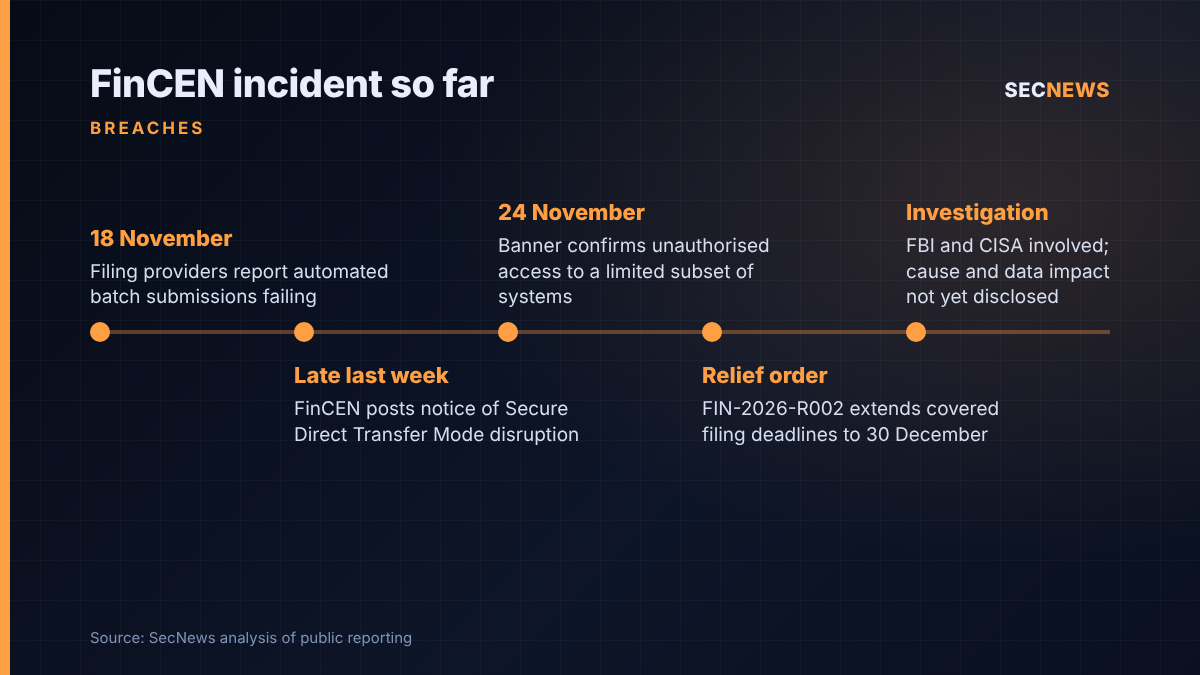
The Financial Crimes Enforcement Network (FinCEN), the Treasury bureau that receives and analyses Bank Secrecy Act (BSA) reports from American financial institutions, posted a banner on its BSA E-Filing website on the evening of Tuesday 24 November (US time). It said the agency was investigating a cyber security incident after an unauthorised party reached “a limited subset of its systems”. Some systems have been switched off as a precaution.
The filing portal itself is still running, although FinCEN warns that certain services may be unavailable for a while. A FinCEN spokesperson told The Record that the FBI and the Cybersecurity and Infrastructure Security Agency (CISA) are involved. CyberScoop reported that outside forensic examiners are also helping to establish scope. According to The Record, investigators have so far found no evidence that the BSA database or the beneficial ownership database has been breached; CyberScoop’s source said the same of the beneficial ownership data.
What the agency has not said matters just as much. It has not named the systems that were reached or those it took down. It has not said when the access began, how the intruder got in, or whether anything was viewed, copied or altered. No group has claimed responsibility. The Verge first reported the incident, and it emerged within hours of separate reports that an unclassified intelligence analysis system used by the CIA and other US agencies had been breached. Whether the two are related is unclear.
The detail
FinCEN has issued a relief order, FIN-2026-R002, to take pressure off filers. According to The Hacker News, reports originally due between 18 November and 29 December can now be submitted up to 30 December. The order covers three groups: institutions that were using Secure Direct Transfer Mode (SDTM) on 18 November, the channel firms use to push batches of BSA reports from their own servers; companies due to file beneficial ownership information in that window; and individuals who need to update a FinCEN Identifier.
The dates are worth noticing. The Hacker News, citing a filing outages report from the markets site The Deep Dive, says filing providers saw automated batch submissions failing from 18 November, and FinCEN posted an SDTM disruption notice late last week. Notably, the relief order cites a “service disruption” and is silent on the intrusion. Whether those failures relate to the intrusion is unknown, and nobody should assume a link.
Nothing else is suspended. Firms must still monitor for suspicious transactions, and FinCEN points filers with urgent matters to its Financial Institutions Hotline, which is unaffected.
This is not the first serious Treasury intrusion. In December 2024, attackers linked to China abused a compromised BeyondTrust API key to get into department systems, and twelve Chinese nationals were later charged over that breach. No connection to the current incident has been reported.
Why it matters for UK organisations
FinCEN is the American counterpart of the UK Financial Intelligence Unit inside the National Crime Agency. The data it holds is about as sensitive as financial data gets: suspicious activity reports name customers who have not been charged with anything, describe internal investigations and reveal what banks have noticed. A leak would harm the people named and the institutions that filed, not just the regulator.
The direct UK impact falls on groups with US-regulated banks, broker-dealers, money service businesses or card and payments operations. Their US entities file through this portal. Compliance teams there now face disrupted channels, a moved deadline and uncertainty over whether anything they submitted has been exposed.
Every regulated firm sends its most sensitive information to regulators and government portals, and supervisory regimes rarely give firms any visibility of how securely it is held at the other end. Bank of England and FCA work on operational resilience has focused on firms’ own important business services. Incidents like this show that a regulatory reporting channel is itself a dependency, and it can fail.
Expert view
In my experience, firms model the loss of their own systems and their key suppliers, but almost never the loss of a regulator’s portal. When we run tabletop exercises with financial services clients, the question “what if the place we report to is the thing that has been compromised?” usually draws a long silence. This incident makes that a practical question rather than a hypothetical one.
“A limited subset of systems” is standard phrasing in early notices, and it can mean anything from a peripheral web server to something closer to the core. The responsible approach is to plan for uncertainty: assume nothing about what was or was not accessed until FinCEN publishes more, and avoid improvised workarounds that move sensitive reports onto less secure channels such as email.
The batch failures from 18 November also deserve attention. If your automated filing jobs failed quietly that week, someone needs to confirm what was actually received. Silent failures in regulatory pipelines are a compliance risk in their own right, whatever caused them.
Finally, expect opportunists. A widely reported outage at a financial regulator is ideal material for phishing. Messages claiming to come from FinCEN, asking filers to “re-submit” reports or to “verify” credentials through a link, are very likely to follow.
What to do now
- Confirm your exposure. Identify every entity in your group that files BSA reports, beneficial ownership information or FinCEN Identifier updates, and which channel each uses (web portal or SDTM).
- Reconcile submissions since 18 November. Check acknowledgements against what your systems believe was sent, and log any gaps for re-filing under FIN-2026-R002 before 30 December.
- Keep sensitive reports on approved channels. Use the Financial Institutions Hotline for urgent matters, as FinCEN advises, and do not fall back on email or file sharing.
- Rotate credentials tied to FinCEN access. Review the accounts, certificates and service credentials used for filing, enforce multi-factor authentication where it is offered, and remove dormant users. This maps to Cyber Essentials user access control and secure configuration.
- Warn compliance staff about phishing. Brief MLRO teams on FinCEN-themed lures and route suspicious messages to your security team. This supports the Cyber Essentials malware protection control.
- Add regulator channels to your resilience mapping. Treat regulatory reporting portals in the UK and abroad as dependencies in your operational resilience and incident response plans, with a documented fallback for each.
Bottom line
FinCEN has confirmed an intrusion but very little else, and it is too early to say whether any filed reports have been exposed. For UK firms with American operations, the immediate job is administrative but important: check what has been filed, use the extended deadline sensibly and watch for scams. The longer-term job is to accept that the places we send our most sensitive data can be breached too, and to plan for that.
Sources
- The Record: Treasury’s FinCEN takes systems offline after cybersecurity incident
- Infosecurity Magazine: US Treasury Investigates Cyber Incident Amid Reported Federal Agency Breaches
- CyberScoop: FinCEN investigates cybersecurity incident, takes systems offline
- The Hacker News: U.S. Treasury’s Financial Crimes Agency Takes Some Systems Offline After Cyber Intrusion
- The Decoder: Back-to-back cyber incidents at US financial investigators and spy agencies