HackerOne says AI-assisted submissions pushed its report volume to a record in the third quarter of 2026, and that software agents now handle about half of all incoming reports. The update lays out how the largest bug bounty platform now filters research, and what organisations running public programmes should expect as a result.
What happened
On 24 November 2026 HackerOne published a progress report by Tony Lee, its VP of Operations, who runs the company’s triage, support and mediation teams. It follows a post from May in which the platform first described how AI tools had changed the shape of its inbound queue.
All the figures below come from HackerOne and have not been independently verified. The company says Q3 2026 was its busiest quarter ever, with volume 130% higher than a year earlier and 22% higher than Q2. October came in only slightly below September’s peak. HackerOne says triage throughput was running at roughly 2.4 times the previous year’s level in October. It also says 92% of new critical reports in October were validated within a day.
The main operational change is automation. HackerOne says its Hai agents now process close to 50% of total volume, closing reports that are clearly spam, duplicates, informative or not applicable. According to the post, these closures were rolled out gradually to groups of programmes, and only once the agents had shown higher accuracy than HackerOne’s baseline; it now says they match or beat its human analysts on those simpler verdicts.
The detail
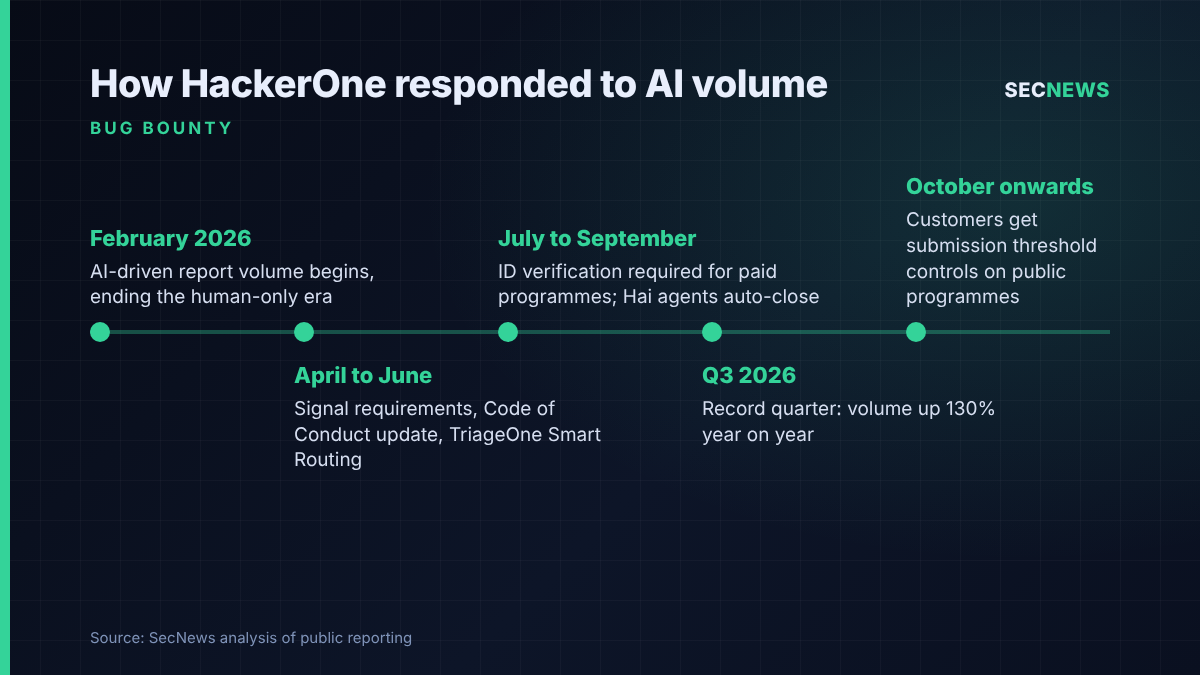
The post gives a timeline. HackerOne describes January 2026 as the last month of purely human submissions and says AI-driven volume arrived in February. Between April and June it added programme signal requirements, reviewed scope and rewards with customers, and updated its Code of Conduct. In the company’s words, the new code makes researchers “responsible for the quality of what they submit”, whether a person or a tool wrote the first draft. It also rolled out TriageOne Smart Routing, which sends reports to analysts according to severity, skill set and the researcher’s track record.
From July to September, identity verification became mandatory before anyone could submit to a paid bounty programme. Unpaid disclosure programmes remain open to unverified researchers. The automated closures were scaled up over the same period and more human triagers were hired. Since October, customers have had new controls over submission thresholds and volume on public programmes.
HackerOne lists two safeguards. If a researcher comments on a report the agents have closed, the report goes back to a human analyst. Programme owners can also reopen any closed report.
Other platforms have done much the same. In October Bugcrowd reported a 388% median increase in submission volume in its queue. It now throttles accounts whose accuracy falls below 50% and puts all new accounts on a restricted footing by default. Intigriti said in mid-October that the industry had moved identity checks from the payout stage to the submission stage for rewarded programmes. It noted that this mainly affects new, anonymous and speculative AI-assisted submitters.
Why it matters for UK organisations
Many UK companies, public bodies and suppliers run their bounty or disclosure programmes through these platforms. Their own procedures assume a human has read every report before it reaches their security team. That assumption no longer fully holds. A machine now decides about half of what gets closed before anyone at the customer sees it. HackerOne says those decisions are accurate, but a wrongly closed duplicate or “informative” verdict could hide a real exposure.
The identity requirement has another consequence. Researchers who will not or cannot verify their identity will be pushed towards unpaid disclosure routes. In the UK, that group includes people who are wary of legal exposure. The Computer Misuse Act still offers no statutory defence for good-faith research. The disclose.io Policy Pulse newsletter noted this week that the Cyber Security and Resilience Bill, which went back to the Commons on 24 November, does not add one. If your disclosure policy is just a copy of your bounty scope, expect more of the unverified noise to land there.
The volume itself is also a signal. If report volume keeps rising this quickly, more bugs are being found in internet-facing estates, including yours. Some will be duplicates from many people running the same tools; others are genuine findings that once took months to surface.
Expert view
I think HackerOne’s direction is sensible. Triage has always been the bottleneck in crowdsourced security, and throwing more humans at a queue that has doubled was never going to work. Using agents for the obvious rejections and keeping experienced analysts for judgement calls mirrors how a good SOC handles alert volume.
What concerns me is the accountability gap. When we test a client’s estate, a finding is only as good as the evidence behind it. The same applies to a closure. A platform reporting its own accuracy is not the same as an independent audit, and customers should ask how false negatives are measured, not just how fast verdicts arrive. The right for researchers to contest a closure is welcome. However, it relies on researchers being engaged enough to push back, and those simply running tooling at scale may be the least likely to do so.
There is a commercial angle too. Platforms now compete on signal-to-noise ratio and speed, and every vendor’s figures should be read as marketing until customers can test them against their own data. The Register reported in May that HackerOne had sharply cut its Internet Bug Bounty rewards.
What to do now
- Review your platform settings. Find out whether automated closures apply to your programme, what thresholds you can set, and whether you can sample closed reports for quality assurance.
- Sample the closures yourself. Each month, read a small random batch of reports closed as duplicate or informative. Escalate any pattern of misjudged findings to your platform account team.
- Separate your intake routes. Give your rewarded bounty, your unpaid disclosure policy and any anonymous reporting option distinct purposes and scope, as Intigriti recommends, and publish a security.txt file in line with the NCSC’s vulnerability disclosure toolkit.
- Plan for more valid findings. Make sure your patching process can absorb a higher rate of confirmed bugs. This ties directly to the Cyber Essentials security update management control.
- Prioritise internet-facing assets. Use bounty findings to refine your asset inventory and firewall rules. Many duplicates point to exposures that are easy to find and should not be public at all.
- Set expectations with researchers. State clearly in your policy how AI-assisted reports are treated and what evidence of impact you need.
Bottom line
HackerOne’s figures confirm that AI has turned bug bounty triage into a volume problem, and automation is now the platform’s main answer. That should mean faster verdicts for organisations, but they should check the machine’s decisions rather than take them on trust. The researchers they most want to hear from may now be reporting through a different route.
Sources
- HackerOne: Navigating the AI Wave: How We’re Keeping Security Research Meaningful
- Bugcrowd: Evolving our submission accuracy and throttling controls to protect triage speed
- Intigriti: What ID verification changes mean for public bug bounty programs
- The Register: HackerOne takes an axe to its bug bounty rewards
- disclose.io: Policy Pulse, Issue #42