An unattributed crew that GreyNoise calls GT13 has taken control of 24 Check Point Security Management servers at 22 organisations, and the UK is among the victim countries. The attackers copied firewall databases and internal certificate authority material, and GreyNoise believes AI agents did much of the work.
What happened
On 23 November 2026, threat intelligence firm GreyNoise published its findings on a campaign targeting Check Point Security Management servers, the central consoles that hold policy for an organisation’s Check Point firewalls. It counts at least 22 victim organisations across 17 countries, including the United Kingdom, Ireland, France, Germany, the Netherlands, Poland, the United States, Australia and several in Asia. Victims work in financial services, energy, government, transport, mining, engineering and manufacturing. GreyNoise saw no focus on any particular sector or country.
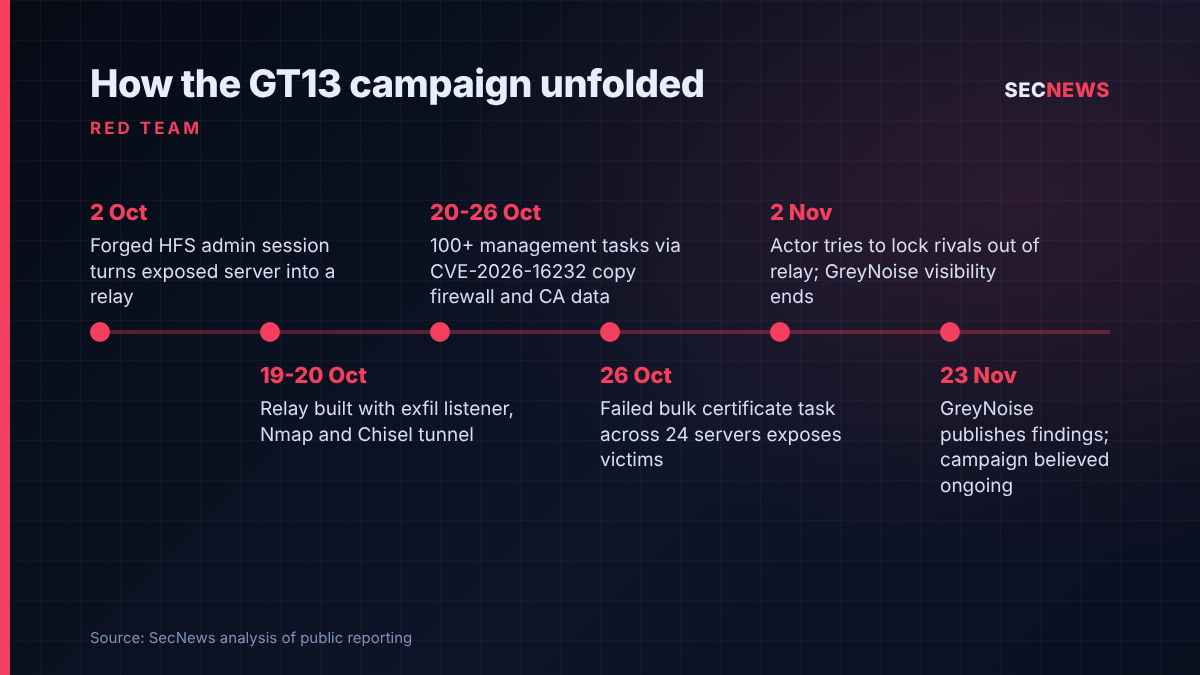
GreyNoise labels the operator GreyNoise Threat 13, or GT13. It has not linked GT13 to a known group and says it cannot yet judge the motive or the country of origin. BleepingComputer reports that GreyNoise thinks the activity resembles espionage. It observed GT13 from 2 October until its view went dark on 2 November. It expects the intrusions are still live because the actor kept persistent access to victims’ Check Point devices. Victims have been notified directly and through government partners and CERTs. Check Point had not commented when BleepingComputer and Cybersecurity Dive published.
The technical picture
GreyNoise saw the campaign because GT13 took over an internet-facing Rejetto HTTP File Server (HFS) and turned it into a relay box, or “hop”. The HFS flaw, CVE-2026-61500, is a weakness in how session tokens were generated, and it let the attacker forge an administrator session without a password. The actor then planted an SSH key for persistence, set up an unauthenticated web listener to receive stolen data, and installed standard open-source tooling: Nmap, the Chisel tunnelling tool, Impacket and Paramiko. At least 30 Python scripts were found on the box.
The key detail is that GT13 already had a foothold on Check Point management servers before it compromised the relay. GreyNoise could not establish when or how that first access happened. Once the actor was in, its main tool was a script for CVE-2026-16232, the SmartConsole authentication bypass that Check Point disclosed in July as an exploited zero-day. Between 20 and 26 October the actor used it to issue more than 100 management tasks. Those tasks copied the firewall database and the Internal Certificate Authority, created a new certificate, and unloaded security policies, which in practice switches the firewall off. A second Check Point server would not report back directly, so the actor collected its credentials and configuration by relaying through the first.
On 26 October an automated job sent a bulk certificate task to 24 compromised management servers. It failed everywhere, but the error output came back to the hop. That gave GreyNoise the victim list and showed that every device held the private half of the SSH key planted on the relay. One error mentioned a suspicious library preload entry, which may indicate an implant. The actor also targeted mostly older, known bugs in Citrix NetScaler, Ivanti Connect Secure, VMware vCenter, Microsoft Exchange and Windows Netlogon. By early November, other threat actors were scanning and probing the relay. GT13 tested it against a recently disclosed Linux kernel networking flaw and tried to add a packet-filter rule so that nobody else could use that bug.
The traffic came from 99 IP addresses, each either an ExpressVPN exit node or a compromised Check Point device. GreyNoise describes a “mature AI-enabled offensive apparatus”, with separate agentic harnesses that find targets, weaponise flaws and build relay networks, and humans at the keyboard in between. That is an assessment, not a proven finding. The evidence is the pattern of stalls, retries and odd troubleshooting in the timeline.
Why it matters for UK organisations
Check Point is widely deployed across UK financial services, the public sector and critical national infrastructure, and the UK is named among the affected countries. GreyNoise has not said how many victims are British. Until UK Check Point customers have checked their own estates, they should treat the campaign as directly relevant.
The stolen data is what makes this serious. A firewall database tells an attacker every rule, object and trusted network you have. An Internal Certificate Authority key can mint certificates that your own gateways will trust, and unloading policy removes the perimeter altogether. Patching does not undo any of that: the CA and configuration have to be rotated and rebuilt, and in my experience that takes much longer than teams expect. For operators of essential services, a compromised policy server is likely to be reportable under the NIS Regulations, and the regulatory stakes rise as the Cyber Security and Resilience Bill progresses. The NCSC warned separately this week that agentic tooling is speeding up attacks on familiar weaknesses.
Expert view
When we test perimeter estates, the management plane is the asset I most want to reach. It is often less hardened than the gateways it controls, everything trusts it, and it is rarely watched as closely as user endpoints. GT13 clearly understood that. It needed nothing novel: a July zero-day that should already be patched, a cheap file server to use as a relay, and a list of familiar edge-device bugs.
The AI angle deserves scepticism and attention in equal measure. None of this was beyond a skilled human. What automation adds is tempo and breadth: one loop working across two dozen victims, password lists tailored to each target, and helper scripts produced on demand. The failures matter just as much. A bulk task that went wrong exposed the entire victim list, which is the brittle behaviour you would expect from a pipeline with no careful human checking each step. Defenders should take some comfort that these operations make mistakes, and should make sure their logging would catch them.
What to do now
- Confirm CVE-2026-16232 is patched on every Security Management Server and SmartConsole installation. If the fix went in late, treat the system as possibly compromised (Cyber Essentials: security update management).
- Take management interfaces off the internet. Allow access only from a dedicated admin network or jump host (Cyber Essentials: firewalls, secure configuration).
- Hunt on management servers for unfamiliar root SSH keys, unexpected library preload entries, Internal CA certificates you did not issue, unexplained policy unloads, Chisel or Nmap binaries, and the indicators GreyNoise has published.
- If you find evidence, treat it as a full rebuild. Rotate administrator credentials, reissue the Internal CA and every certificate that depends on it, and review every rule.
- Find and retire forgotten exposed servers such as HFS and old NetScaler, Ivanti or vCenter instances, which crews like GT13 use as relays.
- Log management-plane actions centrally and alert on bulk tasks, certificate creation and policy changes made outside change windows.
Bottom line
GT13 shows that the most valuable target on a network is often the console that controls its defences, and that automation lets one operator work against many of those consoles at once. UK Check Point customers should patch, hunt for signs of compromise, and plan on stolen certificates and firewall configuration having to be replaced, not merely secured.
Sources
- GreyNoise: An Active Intrusion Campaign Against Check Point Security Management Servers
- BleepingComputer: Hackers compromise Check Point Servers in 22 organizations
- SecurityWeek: Check Point Security Management Servers Hacked in AI-Assisted Campaign
- Cybersecurity Dive: AI-enabled campaign targets Check Point Security Management servers