Lloyd’s of London will build a market-wide extreme disaster scenario to test what artificial intelligence could do to its syndicates’ balance sheets, and it is refreshing its wider disaster scenario framework for 2027. At the same briefing, trade press report, it warned underwriters not to drift back into covering cyber risk inside property policies as rates soften.
What happened
On 26 November 2026 Lloyd’s held its Q4 Market Message, the quarterly session in which the Corporation tells managing agents what it expects of them for the coming year. Rachel Turk, Chief of Performance & Strategy, presented the 2027 business plan. Caroline Sandeman-Allen, Chief of Market Oversight, then outlined how the market will be supervised next year.
The plan targets £74.1bn of gross written premium, 10% above the Q2 forecast, yet like-for-like growth is down 1.5%. Much of the increase comes from new entrants and reinsurance captives. The planned net combined ratio is 92.4%. Turk’s central message, as quoted by Reinsurance News, was that “margin and underwriting discipline must come before volume”.
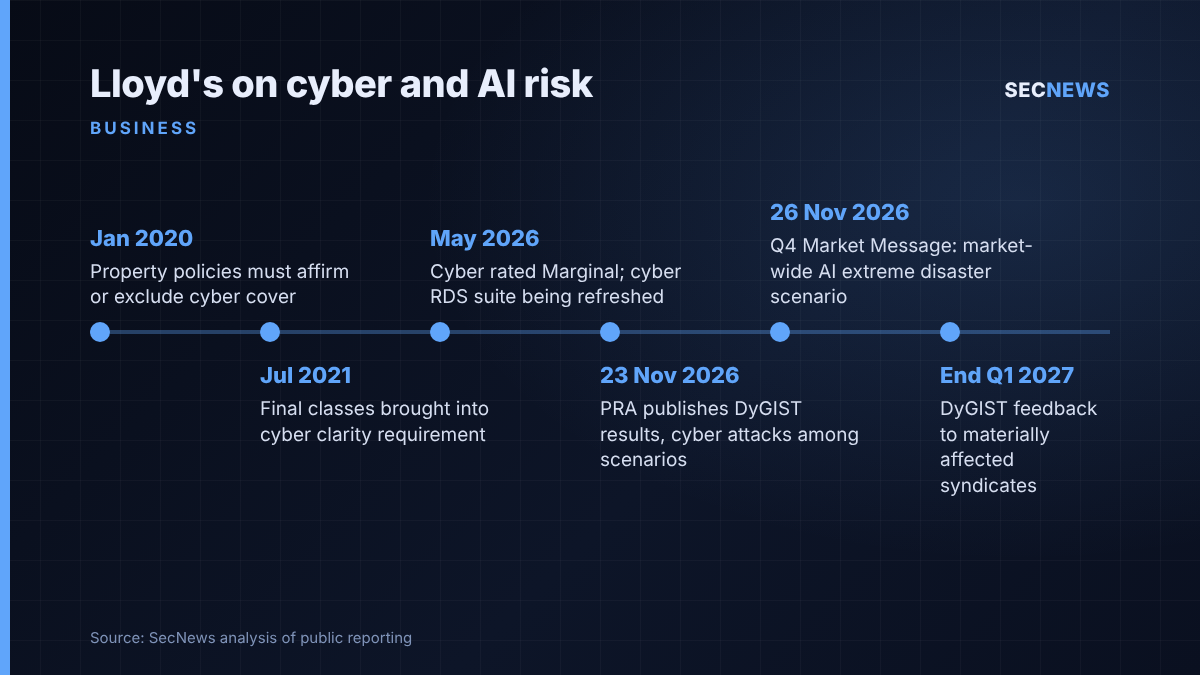
For security leaders, two points stand out. First, Lloyd’s published slides list “AI – financial risk profile” as a 2027 oversight priority, with the action set out as a “market-wide EDS”, or extreme disaster scenario. It sits beside an updated realistic disaster scenario (RDS) framework. Insurance Day reported that the scenario is meant to help the market think about AI exposures in a “consistent and structured” way.
Second, Insurance Day reported that Turk cautioned managing agents against letting cyber exposure return to property wordings. According to Commercial Risk, as summarised by Wisevoter, she said the market was backing away from positions on cyber in property cover that it had worked hard to establish. She reportedly urged agents to check policy terms throughout their books, since wider wordings can mask weak pricing. Both trade articles are behind paywalls, so I have relied on their published summaries for this part.
The detail
Lloyd’s requires syndicates to model standard disaster scenarios so that exposures can be compared on one basis. In the Q2 Market Message in May, Turk said Lloyd’s was refreshing its cyber RDS suite. At the time Lloyd’s rated cyber rate adequacy as “Marginal” with a trajectory of “Rapid Weakening”, and Turk warned that catastrophe assumptions for a class without historical catastrophe loss data are open to wide interpretation.
The AI scenario goes further. The slides give no design or timetable. Calling it an extreme scenario, rather than another realistic one, suggests Lloyd’s wants to see how bad a tail event could get, not just to set a planning benchmark. In my view the obvious candidates are accumulation events: a widely used model, AI platform or agent framework that fails or is abused across thousands of insureds at once, with losses spilling into cyber, professional indemnity, directors’ and officers’ cover and property.
The property warning revives an old fight. Between 2019 and 2021 Lloyd’s made every policy state clearly whether it covered losses caused by a cyber event, either through an exclusion or through affirmative cover. First-party property damage was the first class in scope, for policies incepting from 1 January 2020, and the other classes followed in phases up to July 2021. The aim was to end “silent cyber”, where cover nobody had priced emerged after a loss. If competitive pressure is now loosening those wordings, the hidden exposure returns.
All of this sits within a wider resilience push. Cyber attacks were one of the three event types in the Prudential Regulation Authority’s Dynamic General Insurance Stress Test (DyGIST), which ran in May 2026 and whose results were published on 23 November. Lloyd’s will give affected syndicates feedback by the end of Q1 2027, with market-wide findings by mid-year.
Why it matters for UK organisations
Lloyd’s is central to the UK’s specialist cyber market, and its expectations shape what brokers bring back to UK buyers at renewal. For more than three years the market has favoured buyers: Lockton reported in early November that cyber rate reductions continued into the second half of 2026, although the declines may be slowing. When Lloyd’s stresses discipline over volume, easy renewals rarely last.
The property point matters most to organisations that never bought standalone cyber cover, or bought a small limit, because they assumed their property or business interruption policy would respond to a cyber-triggered outage or physical damage. If cyber language has been quietly broadening and Lloyd’s now pushes agents to tighten it, a gap could open mid-programme, or at the next renewal, without anyone on the buying side noticing.
The AI scenario signals the questions to come. Once a scenario exists, underwriters will want data to run it, and that data will come from proposal forms.
Expert view
I welcome Lloyd’s moving first on an AI disaster scenario. The industry has repeatedly priced new technology risk before it understood the accumulation, and silent cyber was the textbook example. A structured, market-wide scenario forces syndicates to say what they think a bad day looks like, which is the right place to start.
The weak point is evidence. When we test AI-enabled applications, the hardest question is often the simplest: where is AI actually in use, with what permissions, and touching which data? Many organisations cannot answer it, so their insurers cannot either. Any scenario will only be as good as the exposure data behind it, and today that data is thin.
On property, in my experience many risk teams still assume their property programme will respond to an operational technology compromise. That has rarely been safe since 2020, and the wording may now be moving again.
What to do now
- Read your wordings side by side. Put your property, business interruption and cyber policies together and record exactly where cyber events are affirmed, excluded or sub-limited. Ask your broker to confirm in writing whether anything changes at the 2027 renewal.
- Build an AI inventory. List every model, AI service and agent in use, what data and systems each can reach, and who owns it. Apply least privilege and multi-factor authentication to the accounts and keys they use. This maps to the Cyber Essentials secure configuration and user access control requirements.
- Get your control evidence ready. Underwriters reward documented controls. Keep up-to-date evidence for security update management, malware protection and firewalls, the remaining Cyber Essentials areas, along with tested offline backups.
- Ask about your insurer’s resilience. For large exposures, ask carriers how they fared in DyGIST and how far they rely on discretionary support from their group.
- Add an AI failure to your exercises. Run a tabletop on a compromised or misbehaving AI service and check that your incident response plan and insurer notification steps cover it.
Bottom line
Lloyd’s is telling its market that cheap growth is over and that AI needs to be treated as a potential catastrophe risk, not a footnote. For UK buyers, the practical result is closer scrutiny of AI use at renewal and a real chance that cyber cover inside property policies is narrower than assumed. Check the wording now, before a claim does it for you.
Sources
- Lloyd’s: Q4 Market Message 2026
- Lloyd’s: Q4 Market Messages 2026 (slides)
- Reinsurance News: Lloyd’s targets more joined-up oversight as 2027 business plan points to disciplined growth
- Insurance Day: Lloyd’s to develop ‘extreme disaster scenario’ for AI risk
- Wisevoter (citing Commercial Risk): Lloyd’s warned against rolling back coverage
- Reinsurance News: Lloyd’s warns AI is amplifying evolving cyber risk vectors
- Lloyd’s: Market Bulletin Y5277, providing clarity on coverage for cyber exposures
- Insurance Business UK: Lloyd’s says post-loss recapitalisation hinges on market conditions
- Lockton: Cyber Insurance Market Update Q4 2026