The National Cyber Security Centre says AI-assisted attacks on UK organisations have climbed sharply since September, driven by automated hacking frameworks paired with cheap language models. Its message is blunt: the attackers are using no new tricks, just exploiting the weaknesses organisations have left lying around, and doing it far faster.
What happened
On 24 November 2026, the NCSC published a blog titled “Familiar weaknesses, exploited faster: defending against agentic cyber attacks”. Its co-authors include David Chismon, the NCSC’s chief technology officer for architecture. The post reports a marked increase since September in attacks that use what the agency calls “agentic offensive frameworks”. These are tools built for authorised penetration testing and red teaming that are now being turned against real targets.
The NCSC says organisations in several sectors have reported incidents. Internet-facing services were found and attacked one after another in short order. Some services went offline. In other cases systems were compromised, and the attackers used that access as a base for further activity, run by AI agents or in some cases by human operators.
The agency names ARTEX as the framework most associated with this activity, and also lists Cairn, PentAGI, RedAmon, Xalgorix and Darkmoon. The FBI has already warned about ARTEX, and it has reportedly been linked to the recent European Commission compromise. What is new is the UK picture: the national technical authority says this activity is now hitting British organisations, and sets out what defenders should do.
The technical picture
An agentic offensive framework connects a large language model to an ordinary toolkit of scanners, exploit modules and credential tools. The model plans a sequence of steps, runs the tools, reads what comes back and chooses the next move. The NCSC is careful to say that the tools offer nothing a typical attacker could not already get. The difference is the operator. Compared with a human working by hand, the agent goes from discovery to exploitation within minutes, tries every endpoint, parameter and credential it can find, learns from each failure (including by reading error messages), and costs very little to run at scale. The NCSC says this is made possible by cheap, capable open models or by illegal resellers of API access to commercial ones.
The weaknesses being exploited are not exotic. According to the NCSC, the agents are not using memory corruption zero-days, or even known but unpatched CVEs in most cases. They are finding the debt that builds up in every estate over the years: secrets committed to code repositories, misconfigured infrastructure as code, default credentials and services with no authentication at all. Once inside, they take advantage of over-privileged credentials and flat or loosely segmented networks to move around.
The good news is that today’s frameworks are noisy. They send bursts of requests followed by short pauses while the model thinks, hit a huge range of endpoints with parameters that are often nonsense or copied from examples, and produce lots of errors. The NCSC warns that later tools may be built for stealth, so this window may not last.
Why it matters for UK organisations
Many UK organisations have a sprawling, poorly managed internet perimeter and have quietly relied on nobody noticing it. Agentic frameworks remove that protection, because an agent will look at everything and never gets bored. The NCSC says some of the systems breached so far were ones their owners had lost track of, including legacy kit and websites nobody maintained.
This fits the wider framing in the NCSC’s annual review. Launching it, chief executive Richard Horne said the threat is rising “not because AI has invented new ways to attack us”, according to The Record, but because tolerated weaknesses can now be found and exploited at scale. For boards, the uncomfortable point is that the risk register already lists these problems, and they can no longer safely sit there.
Cost matters too. When one operator can aim a framework at thousands of targets cheaply, being small is no longer a defence.
Expert view
When we test external perimeters, the findings that lead to a real compromise are rarely the dramatic ones. They are the API key in a public GitHub repo, the admin panel still using its vendor password, the staging server someone set up years ago. The NCSC is describing the same list, now being worked through by a machine. In my experience the hard part is not knowing what to fix but getting dull hygiene work treated as urgent. This blog gives security teams a useful lever.
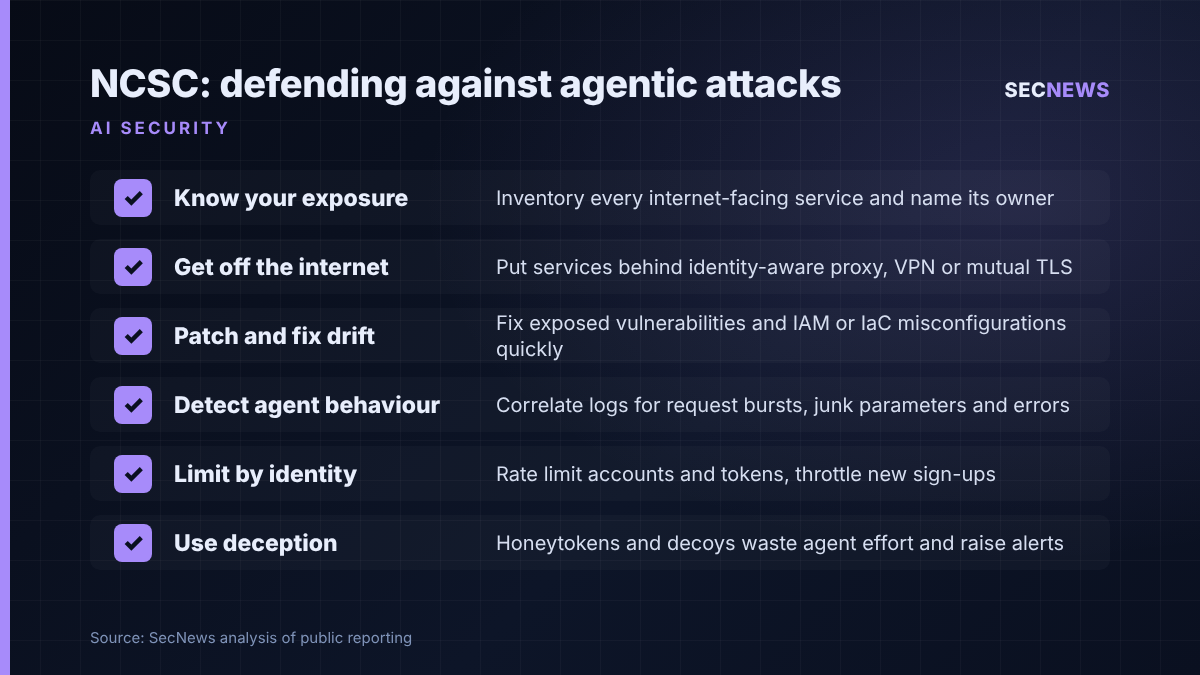
I also welcome the emphasis on taking services off the internet rather than hardening each one. Putting internal applications behind an identity-aware proxy or a VPN, or requiring mutual TLS, shrinks the attack surface far more quickly than patching your way through a long tail of exposed services. The advice on error messages is sound and often ignored: an agent uses every verbose error you return to refine its next attempt.
The deception guidance is worth taking seriously. An agent’s persistence is a weakness. Honeytokens, decoy services and fake successes waste its budget and give defenders high-confidence alerts, because no legitimate user should touch them.
What to do now
- Build and own an external asset inventory. Know every internet-facing host, domain and API, and who is responsible for each. Run or commission your own reconnaissance to find forgotten systems first. This underpins the Cyber Essentials firewall and secure configuration controls.
- Remove exposure before you harden. Move anything that does not need to be public behind an identity-aware proxy with phishing-resistant authentication, a VPN or mutual TLS. Then harden what must stay public.
- Hunt for secrets and default credentials. Scan your public and private repositories for keys and tokens, rotate anything you find, and turn on pre-commit secret scanning. Change default passwords, as Cyber Essentials secure configuration requires.
- Patch internet-facing systems quickly and fix configuration drift. Cyber Essentials already requires high and critical fixes within 14 days. For exposed systems, aim to beat that, and review IAM and infrastructure-as-code settings for gradual changes away from the original design.
- Tune detection for agent behaviour. Correlate web, API and identity logs to spot bursts of varied requests, junk parameters and high error rates.
- Rate limit by identity, not IP. Agents rotate through proxies, so apply limits to accounts, tokens and sessions, make sure APIs enforce the same bot challenges as the web front end, and throttle account sign-up, especially from disposable email domains.
- Strip detail from external error messages and plant honeytokens and decoys where only an attacker would look.
- Reduce privilege and segment networks so that a single foothold does not open up the whole estate.
Bottom line
The NCSC’s warning is not that AI has given attackers new powers. It is that AI has removed the delay that let weak organisations get away with weak security. The fixes are familiar, mostly cheap and documented in Cyber Essentials and the Cyber Assessment Framework. Only the deadline has changed. If an exposed service, a leaked key or a default password is still in your estate, assume an agent will find it soon, and fix it this week, not next quarter.