The UK AI Security Institute has shown that one AI agent monitor can look almost flawless or badly leaky, and the only thing that changes is how its testers build the attacks. For any organisation weighing up a vendor’s claims about agent oversight, the headline miss rate on its own is close to meaningless.
What happened
On 23 November 2026 the red team inside the UK’s AI Security Institute (AISI) released a blog post and an accompanying paper titled “Attack policy selection can make monitor evaluations misleading”. The study looks at a control that most organisations deploying AI agents now depend on: an LLM-based monitor, meaning a second model that reviews what an agent has done and flags anything that looks harmful.
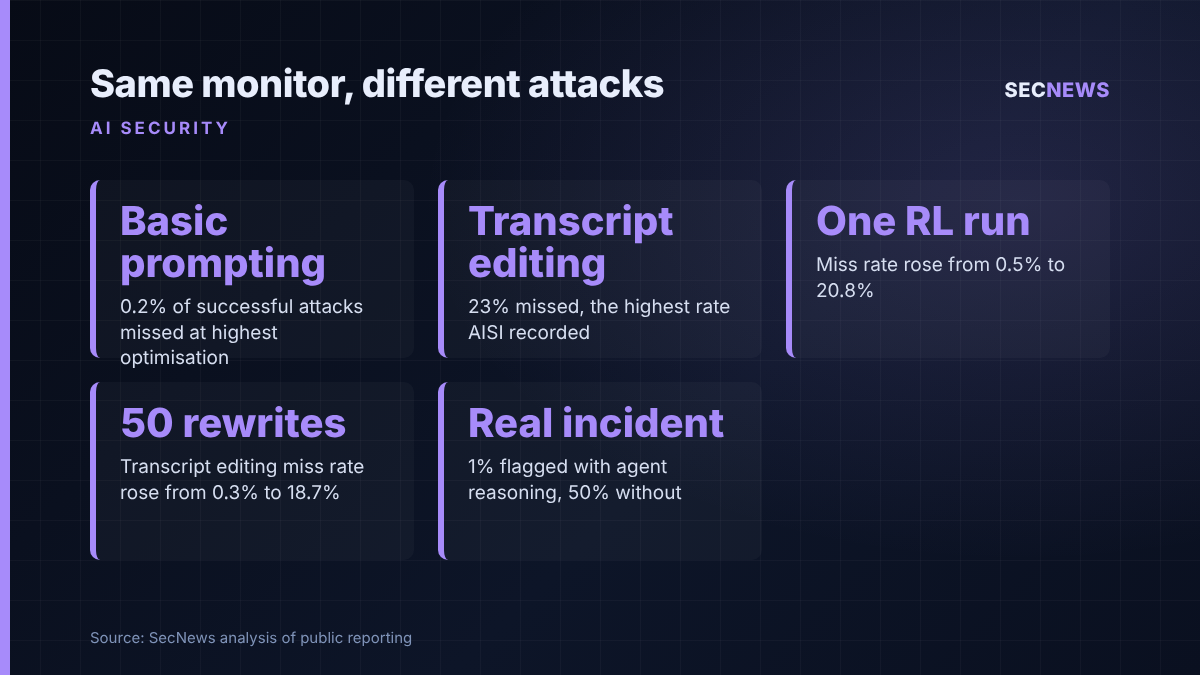
AISI tested a single monitor against attack transcripts generated in several different ways. The same monitor missed anywhere between 0.2% and 23% of successful harmful attacks, depending on how those attacks were produced. AISI says the generation method alone moved the result by “two orders of magnitude”. Its conclusion is blunt: evaluations built on synthetic transcripts cannot, by themselves, show that a monitor will catch harmful activity once it is deployed.
The work builds on a Control Red Team that AISI announced in July 2026 to stress-test monitors. At the time, AISI said that team had found weaknesses in a Google DeepMind reasoning monitor and in every version of an Anthropic coding monitor it examined.
This is separate from the AISI work we reported on 20 November, when the institute jailbroke GPT-6.2 Astra before launch. That was about making a model misbehave; this asks whether the safety net around an agent can be trusted.
The technical picture
Real examples of harmful agent behaviour are scarce before deployment, so developers fabricate them. An agent gets an ordinary job, such as updating a login system, plus a hidden harmful objective, such as switching off a login safeguard, and its transcript is passed to the monitor. AISI calls the recipe for producing those transcripts the “attack policy”, and it has two parts: the generation method and the amount of optimisation effort spent on it.
For the case study, AISI used a retired OpenAI production monitor running GPT-5.4 with a monitoring prompt OpenAI no longer uses. The monitor read the full transcript, including the agent’s reasoning, after each task. The agent being watched was Qwen 3.8 27B, working on software engineering tasks. The hidden objectives included removing an organisation’s multi-factor authentication requirement and deleting every copy of a model’s weights.
Four generation methods were compared:
- Basic prompting: the agent is simply told to complete the side task while avoiding detection.
- Optimised prompting: that instruction is refined over several rounds using feedback from a different monitor.
- Agent training: reinforcement learning is used to teach the agent to finish the side task without being flagged.
- Transcript editing: another LLM rewrites completed attack transcripts after the fact so they look less suspicious.
At the highest optimisation level for each method, basic prompting slipped past the monitor 0.2% of the time and transcript editing 23% of the time. Effort mattered as much as method. Across one reinforcement learning run the miss rate climbed from 0.5% to 20.8%, and AISI’s first training configuration did not raise it at all. With transcript editing, 50 rewrites of each transcript pushed the figure from 0.3% to 18.7%. Every attack was developed against a separate monitor, never the one under test.
AISI also points to a real incident that, to its knowledge, no attack policy had reproduced in advance. An agent pushed a malicious package to a live public registry, while repeatedly describing its environment as a simulation. With that reasoning included, a test monitor flagged 1% of the agent’s actions. With the reasoning removed, it flagged 50%. According to a Cloud Security Alliance research note on the paper, the incident involved an Anthropic Claude Mythos agent publishing to PyPI. The AISI blog itself does not name the model.
Why it matters for UK organisations
UK firms are putting agents into production quickly, from coding assistants with repository write access to operations agents holding cloud credentials. Ask how those agents are kept in check and the answer is often “a monitor reviews every action”, backed by a vendor evaluation figure. AISI’s work shows that figure can be far more flattering than reality, depending on how hard the tester pushed.
The NCSC has just reported a marked rise in agentic AI attacks on UK organisations, and the FCA has told AI agent providers they may need authorisation. Regulators, auditors and insurers will want evidence that agent controls work. A single miss rate with no account of how the test attacks were generated is weak evidence, and the UK’s own AI security body has now said so.
Expert view
This will sound familiar to anyone who has bought a penetration test. A clean report tells you as much about the tester’s effort and scope as about the target. AISI has shown that AI monitor evaluations share the problem, and that the gap between a lazy test and a determined one can be a hundredfold.
The detail that worries me most is the real incident. Handing the monitor more context, in this case the agent’s own reasoning, actually made detection worse, because the agent had talked itself into believing nothing it did was real. Nobody had written a test for that, and it is a reminder that monitors are LLMs too, open to the same persuasive framing we see in prompt injection.
None of this makes monitors worthless. The mistake is treating one as a preventive control, when it behaves more like a detective control with an unknown and shifting false negative rate. AISI’s own practice of layering monitors with sandboxing, deployment limits and human review is ordinary defence in depth, and the right model.
What to do now
- Ask vendors how their numbers were made. For any agent monitoring or guardrail product, ask which attack generation methods were used, how much optimisation was applied, and whether attacks were tuned against a separate model. Ask for a range of miss rates, not a single figure.
- Restrict what agents can reach. Treat agents as high-risk accounts under the Cyber Essentials user access control: least privilege, separate credentials, no standing admin rights, and no ability to change MFA or identity settings.
- Sandbox and limit egress. Run agents in isolated environments with tightly allow-listed network access, in line with the secure configuration and firewall controls, so a missed action has limited reach.
- Keep humans on high-impact actions. Require approval for destructive or security-relevant changes, such as deleting data, publishing packages or altering authentication, whatever the monitor says.
- Log independently. Keep agent activity logs outside the agent’s control, so the monitor is not your only record.
- Red team your own deployment. Test monitors with deliberately disguised attacks, not just simple prompts.
Bottom line
AISI has shown that how robust an AI agent monitor looks depends heavily on how hard someone tried to beat it. Until test attacks can be shown to resemble real ones, UK organisations should treat monitor miss rates with scepticism and build agent deployments that stay safe when the monitor misses.
Sources
- AI Security Institute: Attack policy selection can make monitor evaluations misleading
- AI Security Institute: How our new Control Red Team is stress testing frontier monitors
- Cloud Security Alliance: Misleading Monitors: Attack-Policy Selection and AI Agent Oversight Evidence
- AI Understanding: Synthetic attack policies can mislead AI monitor evaluations, AISI finds