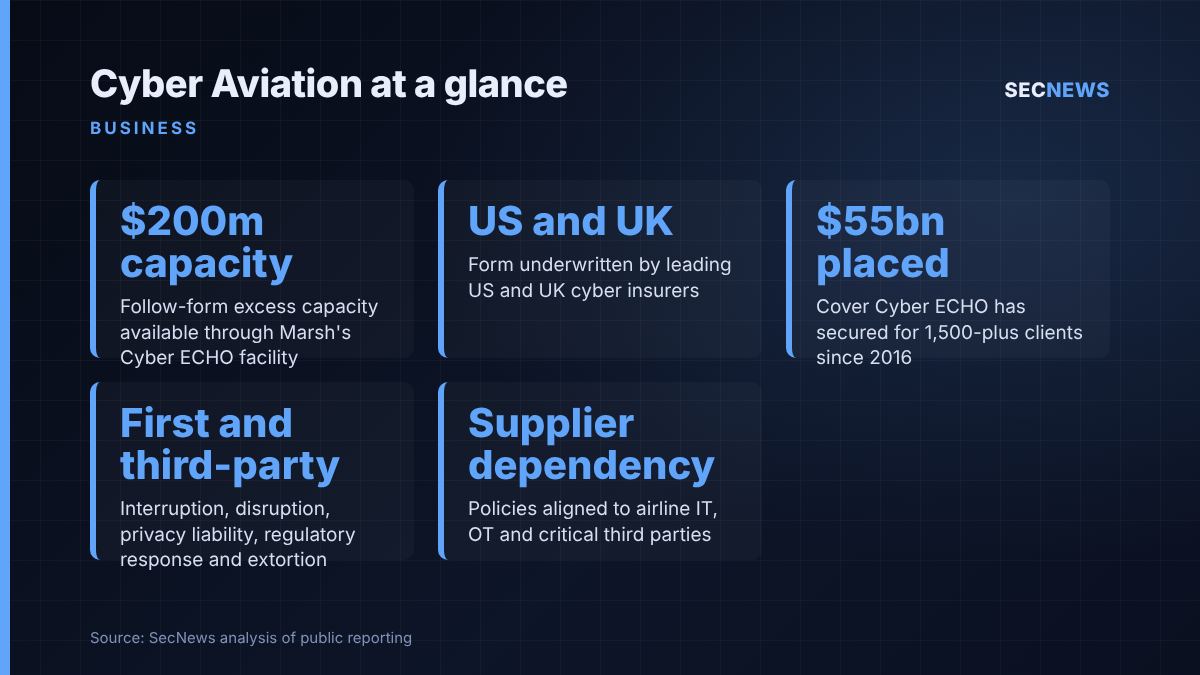
Marsh has launched Cyber Aviation, a cyber insurance form written specifically for airlines, with up to $200 million of excess capacity available through its Cyber ECHO facility. The product puts airline IT, operational technology and supplier dependency at the heart of underwriting, and that should change how UK carriers and their suppliers prepare for renewal.
What happened
On 23 November 2026, the broker Marsh announced Cyber Aviation, an insurance form built around the way cyber losses actually unfold at an airline. Marsh says the wording is underwritten by “leading US and UK cyber insurers”, although it has not named them. Business Insurance, reporting the launch on 24 November, also described the capacity as coming from both sides of the Atlantic.
The headline number is $200 million. That figure is not the limit of a single primary policy. It is the follow-form excess capacity that Marsh’s Cyber ECHO facility can stack above an airline’s own programme, with a reinstatement feature so cover does not simply vanish after one event. Marsh enlarged Cyber ECHO to that size in April, when Insurance Journal reported that the facility draws on insurers in the Lloyd’s, company and Bermuda markets, and has placed more than $55 billion of cover for upwards of 1,500 clients since 2016.
Tom Reagan, who leads Marsh Risk’s global cyber practice, framed the launch around the sector’s interconnection, calling aviation “a uniquely connected environment” in which a single event can produce losses across several parties.
The detail
The form covers both first-party and third-party exposures. On the first-party side, Marsh lists network interruption, operational disruption and cyber extortion. On the liability side, it covers data and privacy claims and the cost of dealing with regulators. Optional extensions can pick up certain passenger-related and cargo-related costs, which is where airline losses become very different from those of an ordinary corporate.
The more interesting design choice is that policies can be shaped around an airline’s own IT and operational technology estate, and around its reliance on specific technology providers and other critical third parties. In plain terms, the wording is meant to reflect how an outage at a booking platform, ground-handling system or other outsourced service ripples into cancelled departures, stranded passengers and compensation claims.
Business Insurance highlighted flight operations, booking and ticketing, and third-party technology dependency as the areas where cover can be tailored. Marsh also pointed to tightening regulatory scrutiny of cyber governance and reporting, which puts airline boards under pressure to show they have thought about risk transfer, not just controls.
Why it matters for UK organisations
There are three UK angles here. The first is capacity. With UK insurers among the underwriters, although none has been named, and Cyber ECHO drawing on Lloyd’s, a meaningful share of this risk is likely to sit in the London market. That matters at a time when the market is soft. Lockton’s Q4 2026 update says cyber rates were still falling into the second half of the year, although the decline may be slowing, and that the Lloyd’s Q2 2026 market assessment rated cyber insurance adequacy as “marginal”. Insurers who are cutting prices while worrying about margins will look hard at any sector with concentrated, correlated losses, and aviation is exactly that.
The second angle is the operators themselves. UK airlines and airport groups are attractive targets, and they are already making difficult extortion decisions: Check Point’s Q3 2026 ransomware report lists Manchester Airports Group among organisations that publicly refused a ransom demand during the quarter. When the business has to keep running through an incident, the questions of who pays for disruption and what the policy will respond to become operational, not theoretical.
The third, and in my experience the most overlooked, is the supply chain. A product that explicitly underwrites dependency on named technology providers creates pressure further down the chain. Managed service providers, software vendors, baggage and check-in platforms and ground handlers serving UK airports should expect more detailed security questionnaires, contractual requirements and evidence requests as airline insurers try to understand where the aggregation sits.
Expert view
Sector-specific wordings are, on balance, a good thing. Generic cyber policies were written for organisations whose main fear was data theft. An airline’s worst day looks very different: departures held at the gate, crews out of position, passengers to rebook and compensate, cargo stuck on the ramp. A wording that names those costs should reduce the arguments that follow a claim.
The catch is that tailored cover brings tailored underwriting. When we test airline and airport environments, the hardest conversations are rarely about the perimeter. They are about the flat connections between corporate IT, operational systems and supplier remote access, and about who actually owns the risk when a shared platform fails. Underwriters writing $200 million towers will want answers to those questions, and they will want evidence rather than policy documents.
I would also urge caution on the word “capacity”. Excess layers follow the primary wording, so the quality of the underlying policy, its definitions of system failure and dependent business interruption, and its waiting periods all determine whether that headline limit ever pays out. Boards should not treat a large tower as a substitute for being able to recover quickly.
Finally, accumulation. If several carriers rely on the same few technology providers, one supplier failure could trigger many claims at once. How the underwriters price that as rates soften elsewhere is worth watching at the next renewal cycle.
What to do now
- Map your critical dependencies. List the technology providers and third parties whose failure would stop operations, and document the business impact of each. Underwriters will ask for it.
- Review dependent business interruption cover. Check whether your current policy responds to outages at suppliers, both malicious and non-malicious, and what waiting periods apply before cover starts.
- Segment IT from operational systems. Evidence of firewalls and secure configuration between corporate networks and operational technology, in line with the Cyber Essentials controls, will strengthen both your defences and your underwriting submission.
- Tighten supplier remote access. Enforce multi-factor authentication, least-privilege user access control and time-limited sessions for third-party support connections.
- Rehearse recovery, not just detection. Run exercises that assume a supplier platform is unavailable for days, and record recovery times. Tested backups and manual workarounds are what reduce a claim.
- Decide your extortion position in advance. Agree with the board, legal advisers and insurer how ransom demands will be handled, so the decision is not improvised mid-incident.
- Suppliers: prepare your evidence pack. If you serve airlines or airports, expect deeper assurance requests. Current Cyber Essentials Plus certification, penetration test summaries and incident response plans will shorten the conversation.
Bottom line
Marsh’s Cyber Aviation form is a sign that the cyber market is moving from one-size-fits-all policies to cover priced on how a particular sector breaks. For UK airlines, airports and the suppliers behind them, the cover may be welcome, but the scrutiny that comes with it will be tougher. Organisations that can show their dependencies, segmentation and recovery capability will get better terms. Those that cannot will find the headline $200 million of capacity harder to reach.
Sources
- Marsh: Marsh launches Cyber Aviation, dedicated cyber coverage to better protect global airlines
- Business Insurance: Marsh launches global airline cyber insurance
- Insurance Journal: Marsh Risk enhances cyber facility with up to $200M of capacity
- Lockton: Cyber Insurance Market Update Q4 2026
- Check Point Research: The State of Ransomware Q3 2026