Broadcom has released fixes for 23 VMware flaws, three of them rated 9.8, that put vCenter logins and ESX hosts within reach of anyone with network access. Nothing is known to be exploited yet, but recent history says UK virtualisation teams should not wait for that to change.
What happened
On Tuesday 24 November 2026 Broadcom published VMware Security Advisory VMSA-2026-0011, rated Critical overall. It covers 23 separate vulnerabilities spread across vCenter, ESX, Workstation, Fusion, VMware Tools and the Avi Load Balancer, with individual severity scores running from 3.4 up to 9.8.
Three issues stand out. CVE-2026-123903 is an authentication bypass in the directory service built into vCenter. CVE-2026-123910 (heap out-of-bounds write) and CVE-2026-123911 (use-after-free) both affect the ESX I/O filter service. All three score 9.8, and none needs a foothold inside a virtual machine: being able to reach the service over the network is enough.
Broadcom does not list any of the flaws as exploited. SecurityWeek points out that the company often leaves exploitation status out of its advisories, so silence is not the same as reassurance. The timing also matters. Only five days earlier Broadcom fixed a different vCenter authentication bypass in an earlier advisory, one that Mandiant says a China-linked group had exploited as a zero-day, which secnews.co.uk covered at the time.
According to SecurityOnline, the ESX I/O filter bugs were reported by CrowdStrike and by DEVCORE through Trend Micro’s Zero Day Initiative.
The technical picture
The vCenter problem sits in the directory component that underpins single sign-on. Broadcom’s own description is blunt: an attacker who can reach vCenter may skip authentication and obtain unauthorised access. Three more Directory Service bugs (CVE-2026-123905, -123906 and -123907) allow denial of service against the same component. Broadcom stresses that these flaws live in vCenter itself, so it makes no difference whether Enhanced Linked Mode is in use.
On the hypervisor side, the two I/O filter flaws are memory-safety bugs in a host service. A successful attack gives code execution on ESX itself, which in practice means every guest running on that host is exposed. The I/O filter framework is what storage and replication products hook into, so it is not an obscure corner that most estates have switched off.
The advisory also fixes a VM escape class issue. CVE-2026-123912 sits in the virtual XHCI USB controller, where a write can run past the end of a buffer. Someone with administrative rights inside a guest can run code as the VMX process that hosts it. On ESX that is contained by the VMX sandbox (CVSS 8.5), but a companion bug, CVE-2026-123913, a VMkernel stack overflow, lets an attacker already inside VMX raise privileges. On Workstation and Fusion the XHCI bug scores 9.3 because it can lead to code running on the desktop host.
The remaining fixes include an arbitrary file write in vCenter archive handling, a local privilege escalation in a vpxd script, a vSphere Distributed Switch policy enforcement failure, ESX signature and configuration store bypasses, a VGAuth denial of service in VMware Tools, and eight Avi Load Balancer bugs including deserialisation, command injection and an authentication bypass. Most of these need existing access or privileges.
Why it matters for UK organisations
vSphere remains the backbone of a large share of UK private cloud, from local authority data centres and NHS trusts to managed service providers hosting dozens of customers on shared clusters. vCenter and ESX are also the prize ransomware crews have chased for years: control the hypervisor and you can encrypt or destroy every workload and, often, the backup proxies too.
An unauthenticated route into vCenter is about as valuable as access gets. Combined with the recent zero-day activity against the same directory component, it is reasonable to assume capable actors are now diffing these patches. The NCSC has repeatedly warned that the window between a fix appearing and exploitation is shrinking, and an advisory with three 9.8 scores is exactly the kind of release that tests that.
There is also a licensing and support angle peculiar to the post-acquisition VMware world. vSphere 7 left general support on 2 October 2025. Broadcom says older versions should be presumed vulnerable, and only customers with extended support contracts can request patches for 7.0. Plenty of UK organisations delayed upgrades while renegotiating licences, and they now face a critical advisory with no straightforward fix.
Expert view
In my experience, vCenter is the single most over-trusted system on an internal network. When we test, it is common to find it reachable from ordinary user VLANs, from VPN pools and occasionally from the internet, simply because nobody ever drew a firewall rule around it. An authentication bypass against that interface turns a phishing foothold into domain-wide infrastructure control in a very short time.
The ESX bugs worry me for a different reason. Management interfaces on hosts are often treated as “inside the trusted zone” and left open to whole server ranges. If an attacker lands on any server in that range, a network-reachable code execution flaw on the hypervisor is a direct path out of the guest world and into the platform.
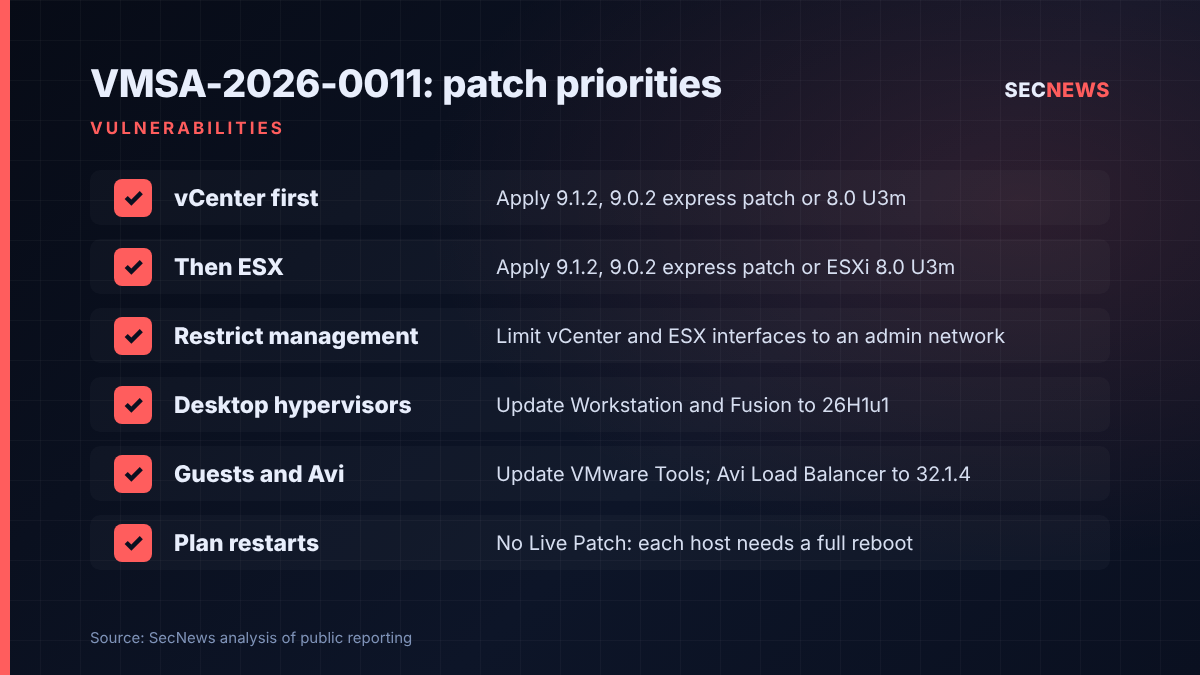
The operational detail matters too. Broadcom confirms these updates are not eligible for vCenter Quick Patch or ESX Live Patch, so each host needs a full restart, and the XHCI fixes only apply once a VM is powered on or migrated to a patched host. Teams that rely on rolling maintenance windows should plan for that rather than discover it mid-change.
What to do now
- Patch vCenter first. Move to 9.1.2, the 9.0.2 express patch or 8.0 U3m as appropriate. Check the interoperability matrix so the new vCenter supports your current ESX builds.
- Patch ESX next. Apply 9.1.2, the 9.0.2 express patch or ESXi 8.0 U3m. Cloud Foundation 5.x customers should follow Broadcom’s asynchronous patching process (KB 88287), and note that updating SDDC Manager alone does not update ESX.
- Lock down management networks today. Restrict vCenter and ESX management interfaces to a dedicated admin network and jump hosts. This maps directly to the Cyber Essentials firewall and secure configuration controls, and buys time while patching is scheduled.
- Update Workstation, Fusion and Tools. Developer and admin laptops running Workstation or Fusion need 26H1u1. VMware Tools inside guests (13.1.10 or 12.5.6) is updated separately from the host.
- Review Avi Load Balancer. Version 32.1.4 resolves all eight issues; some older branches only fix a subset.
- Deal with vSphere 7. If you are on an end-of-support release without an extended contract, treat this as the trigger for an upgrade plan and apply compensating network controls immediately.
- Hunt quietly. Review vCenter SSO and Directory Service logs for unexpected sessions or new accounts, given the recent zero-day activity against the same component.
Bottom line
This is not yet an exploited-in-the-wild emergency, but it is the closest thing to one without the label. Three network-reachable 9.8 flaws in vCenter and ESX, landing days after attackers proved interest in the same directory service, should go to the top of this week’s change board. Patch, restrict management access, and do not let licensing arguments leave your hypervisors exposed.