
UK security firm Intruder paid about $3 per hit to take control of 28 live subdomains in public bug bounty scopes, including five belonging to the US Treasury, by claiming recycled AWS IP addresses that old DNS records still pointed to. Intruder says every finding was reported through the proper channels and fixed, but AWS says it will not change how its address pool works, so this class of bug is still wide open.
What happened
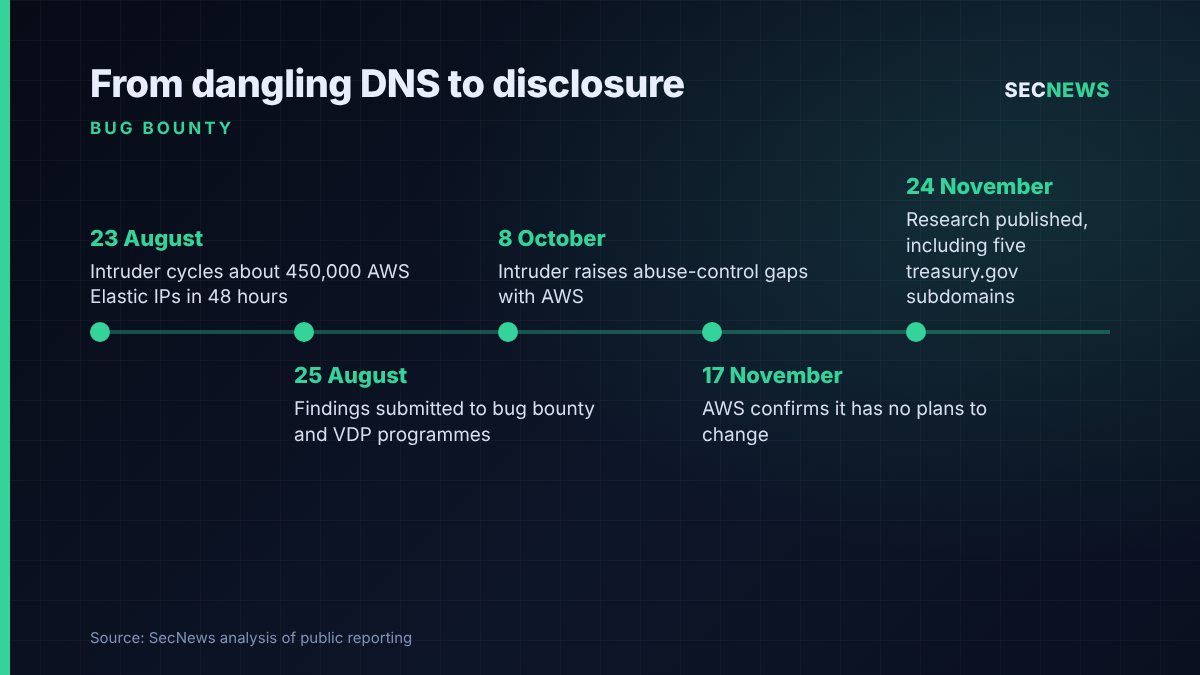
On 24 November 2026, Intruder published research by security consultant Tom Steer showing that dangling DNS records pointing at Amazon Web Services Elastic IP addresses can still be hijacked cheaply and at scale. Intruder, an English company once selected for GCHQ’s Cyber Accelerator, ran the test in August. Over 48 hours, the team cycled through roughly 450,000 unique Elastic IPs. They checked each one against the DNS records of organisations that publish bug bounty or vulnerability disclosure scopes.
That run produced 28 live takeovers. In each case Intruder held the IP address that a real, resolving subdomain pointed to. Almost half belonged to government bodies. The best-known were five hosts under treasury.gov: ftp, irssearch, pcp, rdgw and ww5. Other hits included a university, a financial services firm and a big networking supplier; the remainder were Intruder customers, who were told directly.
The disclosure went by the book. Findings went to the relevant bug bounty and VDP programmes on 25 August, and Intruder says the Treasury issues were fixed through a bug bounty programme. Intruder then raised its wider concerns with AWS on 8 October and followed up on 10 November. On 17 November AWS replied that it had no plans to change anything.
The technical picture
The root cause is well understood. An organisation points a DNS A record at a cloud address, later shuts the server down and gives the address back to the provider, but forgets to delete the record. The address returns to a shared pool and can be handed to any other customer. As AWS’s own documentation puts it, an Elastic IP belongs to your account only until you release it. Whoever ends up holding it controls whatever the stale subdomain serves.
What Intruder showed is that getting hold of a specific address is a numbers game, and a cheap one. AWS hands out Elastic IPs at random, so an attacker cannot simply request the one they want. Instead they allocate and release addresses repeatedly and keep any that match a target list. Intruder built its list only from public bug bounty scopes. In 48 hours it covered about 0.56% of the roughly 80 million IPv4 addresses AWS publishes for EC2, and that was enough for 28 confirmed takeovers.
AWS did act. After two days it sent an abuse warning and blocked the account from allocating or associating Elastic IPs. The weak point, according to Intruder, is that the restriction applied to one account rather than the whole organisation. The team could still move the addresses they had already claimed into a sister account in the same AWS organisation, which they did so they could host proof-of-concept pages for the programmes. They proposed a monthly allocation cap and organisation-wide enforcement. AWS’s position is that takeovers depend on customer-side DNS hygiene rather than a flaw in its service, and that it already treats rapid allocation and release as a policy breach.
The impact goes well beyond a defaced page. Anyone holding a stale subdomain can obtain a valid TLS certificate through ordinary domain checks, so a phishing page on a real .gov host would show the padlock users are told to look for. Old scripts and integrations that still call the retired hostname may send it credentials. Cookies scoped to the parent domain will also be sent to the hijacked subdomain, which opens the door to session theft against unrelated applications on the same domain. Intruder harvested no data.
Why it matters for UK organisations
None of this is specific to America. Intruder notes that AWS publishes which address ranges belong to which region. For a target hosted in London (eu-west-2), that cuts the search space to around 2.2 million addresses, although repeated allocation within a single region produced more duplicates and slowed the search. An attacker targeting a UK council, NHS trust or bank on AWS London faces a far smaller haystack.
UK public bodies have spent years teaching citizens to trust gov.uk and nhs.uk addresses. A hijacked subdomain on one of those domains, carrying a valid certificate, would make a highly convincing lure. For businesses, the cookie risk matters most where single sign-on shares sessions across a corporate domain.
There is also a lesson here for organisations weighing whether to run a bug bounty or VDP. Intruder only reported these findings because the targets had published scopes and a route for reports to come in. An organisation with no disclosure route would simply never have heard from a researcher, and a criminal would not have bothered to tell them.
Expert view
When we run external attack surface assessments, stale DNS is among the most common findings, and it is nearly always a process failure rather than a technical one. The team that decommissions a server is rarely the team that owns the DNS zone, and nobody’s change ticket includes “delete the record”.
I have some sympathy for AWS’s position, since it cannot know which of millions of customer records are stale. But Intruder’s point about account-level bans is a fair one. If an abuse control can be sidestepped by opening a sister account, it slows attackers down without stopping them. Until providers tighten this, UK organisations should assume that any dangling A record pointing at a public cloud range can be claimed by someone else, and treat it with the urgency of an exposed admin panel rather than as low-priority hygiene.
What to do now
- Inventory every public DNS record across all your domains and providers, including old marketing and project subdomains. This underpins the Cyber Essentials requirement to know your internet-facing assets.
- Check each A and AAAA record against what you actually hold. Any record pointing at a cloud IP that is not allocated to one of your accounts should be removed or corrected straight away.
- Change your decommissioning order. Delete or update DNS first, then release the address.
- Review cookie scoping. Avoid setting session cookies on the parent domain where host-only cookies will do, so one lost subdomain cannot expose sessions elsewhere (Cyber Essentials: secure configuration).
- Monitor continuously. Use attack surface monitoring and certificate transparency alerts to catch unexpected certificates issued for your subdomains. Eligible public sector bodies can register domains with the NCSC’s Web Check service, as the NCSC’s domain management guidance recommends.
- Publish a disclosure route. A security.txt file and a simple VDP let the next researcher reach you.
Bottom line
Intruder showed that taking over a government subdomain cost less than a cup of coffee. The affected organisations were told, and the records fixed, because there was a disclosure route to report through. AWS has declined to make the attack harder, so the only reliable defence is your own DNS hygiene, and UK organisations on AWS London should audit their records this week.