A new QBE survey suggests UK businesses think attackers are going after finance and IT, while the boardroom gets overlooked. The insurer’s report with Control Risks also warns that suppliers you don’t control may decide how quickly you recover.
What happened
On 25 November 2026, business insurer QBE published new research on how UK organisations see cyber risk. It ran alongside a resilience report produced with consultancy Control Risks, titled The new anatomy of a cyber crisis. The survey work was carried out by Opinium, which polled 500 UK business decision makers.
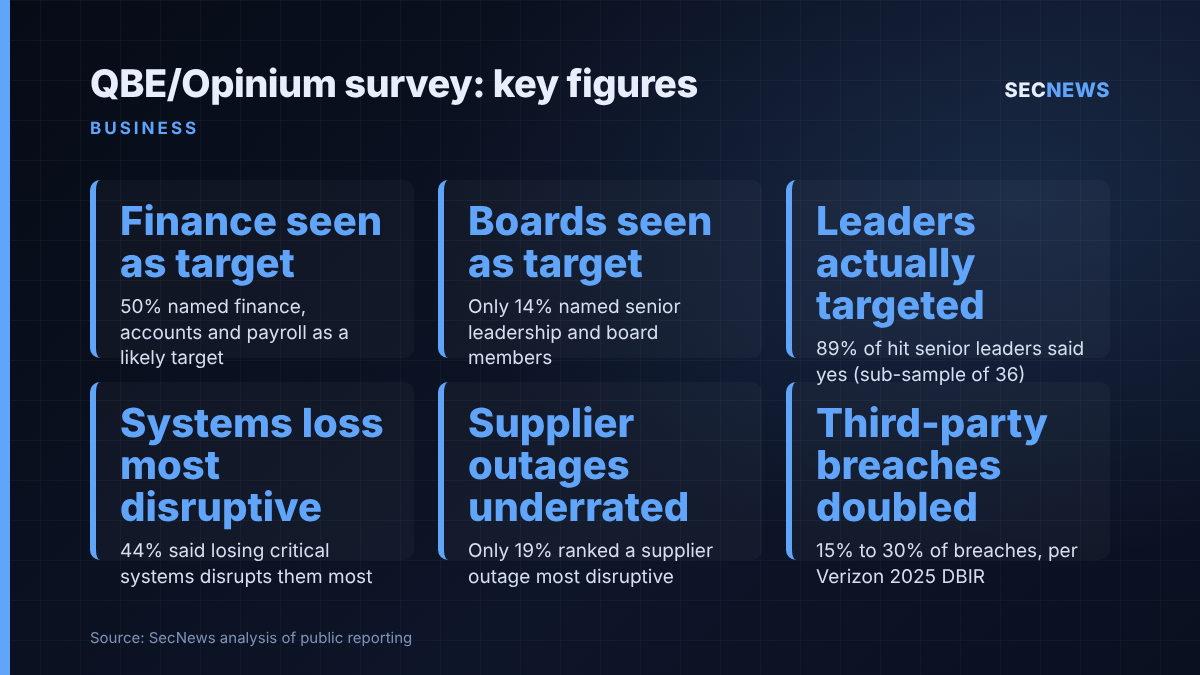
The headline finding is about perception. According to QBE and Opinium, half of respondents picked finance, accounts and payroll as one of their top three likely targets, and 46% named IT, technology and security. Only 14% put senior leadership and board members on that list.
QBE then asked people at organisations hit by an attack, incident or suspected threat during the last year whether their own function had been directly targeted. Among senior leaders and board members, 89% said yes. That figure needs a health warning. It comes from a sub-sample of just 36 respondents, and Insurance Business UK describes it as indicative rather than definitive.
QBE’s cyber portfolio manager, David Warr, described senior figures as “attractive targets for cyber attacks”, given that they approve decisions, oversee critical infrastructure and handle financial transactions.
The detail
When asked what kind of incident disrupts them most, 44% of respondents pointed to losing critical systems, software or cloud services. Next came theft or exposure of sensitive information at 41% and payment fraud or invoice redirection at 34%. Physical disruption to operations scored 28%, ransomware 27% and a supplier or vendor outage only 19%. Respondents said phishing (46%), AI-generated or cloned voice scams (36%) and malware (36%) had become more common over the past year. Among senior managers and above, the voice scam figure rose to 38%.
The low score for supplier outages is where the Control Risks analysis pushes back hardest. The report calls suppliers the fastest-growing route into businesses. It cites Verizon’s 2025 Data Breach Investigations Report, which found the share of breaches involving a third party doubled from 15% to 30%. It also cites NCSC data showing that only around 30% of the UK’s medium and large organisations had carried out a formal assessment of supplier cyber security over the past year. When a critical provider fails, the report warns, recovery is “often set by someone else’s timetable”.
The wider report covers 14 markets, the UK among them. Coverage of the report in the Italian trade press highlights a few broader findings:
- Control Risks counts a 611% rise between 2020 and 2026 in organisations named on ransomware leak sites, and projects a further 14% in 2027. This covers named victims only, not every victim worldwide.
- AWS, Microsoft Azure and Google Cloud took 63% of enterprise cloud infrastructure spending in the third quarter of 2025, so one provider failing can hit many sectors at once.
The report sets out four tests that separate a contained incident from a crisis. Can you detect an intrusion early? Can you contain it before it reaches operational systems? Can critical services keep running while systems are down? Have executives, not just technical staff, rehearsed it? According to Control Risks, what usually decides the outcome is how much of the business relied on the system that failed, not how sophisticated the attacker was.
Why it matters for UK organisations
QBE’s global head of cyber, Serene Davis, made the underwriting point directly. Two companies with apparently similar controls can carry very different loss exposure. The difference depends on whether critical services have been mapped, networks segmented, backups tested and alternative suppliers lined up.
There is also a coverage gap. Cyber policies differ widely in how they respond to business interruption caused by a third party’s failure. A firm that has never mapped which suppliers it cannot operate without has no way of knowing whether its policy would pay out after a key supplier goes down. The global Microsoft 365 outage on 12 November caused wide disruption, yet brokers have so far reported few claims or confirmed losses. Policy triggers and waiting periods also shape what is recoverable. Separately, the PRA’s latest general insurance stress test also flagged gaps in insurers’ cyber exposure data.
For smaller firms the message is double-edged. SMEs use the same platforms and supply chains as large enterprises with far fewer resources. If they supply larger organisations, their weaknesses become their customers’ entry point. Expect more supplier questionnaires, more contract clauses and more evidence requests flowing down UK supply chains, especially as the Cyber Security and Resilience Bill brings managed service providers into scope.
Expert view
The finding that boards are overlooked as targets fits what I see in practice, even if a sample of 36 can’t prove it. When we run social engineering assessments, the most productive targets are rarely the people who have done the most phishing training. They are the people whose instructions get followed without question. A convincing message or cloned voice that appears to come from the chief executive or finance director gets a payment approved or a password reset done. The board is often the least tested part of the organisation, partly because nobody wants to phish the chair.
In my experience, the second blind spot is dependency mapping. Most organisations can give you an asset register. Few can tell you which three external services must be up for them to take an order, pay staff or ship goods, or what they would do if one disappeared for a fortnight. That is a business continuity question, and it belongs with the people who own the risk, not just the IT team.
What to do now
- Bring the board into scope. Include executives and non-executives in phishing and vishing exercises. Agree out-of-band verification for any payment or access request said to come from a senior leader, such as a call back on a known number.
- Harden executive accounts. Apply phishing-resistant MFA to senior and finance accounts first, and remove admin rights they do not need. This maps to the Cyber Essentials user access control requirements.
- Map critical dependencies. For each critical service, list the systems, suppliers and sub-suppliers it needs, a realistic recovery time and a fallback.
- Assess your key suppliers. Formally review the security of the handful of suppliers you cannot work without. Ask for Cyber Essentials or Cyber Essentials Plus as a baseline.
- Read your policy against those dependencies. With your broker, check how your cyber cover treats non-malicious outages, third-party failure and waiting periods.
- Rehearse a supplier outage. Run a tabletop exercise where a cloud or software provider is down for days, with executives in the room. Test backups by actually restoring from them.
Bottom line
QBE’s research makes two points UK boards should take personally. Attackers may be aiming at them more than they assume, and a supplier’s bad day can become their crisis. The 89% figure is indicative only. The case for testing the boardroom, mapping supplier dependencies and reading the policy wording before something goes wrong does not depend on it.
Sources
- Insurance Business UK: UK businesses underestimate board exposure in cyber threat picture
- Insurance Edge: New Cyber Risk Report From QBE
- Assinews: QBE Cyber Report 2026, ransomware atteso un +14% nel 2027
- Insurance Business UK: Disruptions that stopped whole sectors left brokers reporting few claims