BT has launched Cyber Prepared UK, a national training drive that will put small businesses through simulated ransomware and social engineering attacks from February 2027. The telecoms group is backing it with a 100,000-hour training pledge, a partner list that includes the NCSC, Microsoft, Anthropic and CrowdStrike, and its own data showing a more than 500% jump in hostile scanning.
What happened
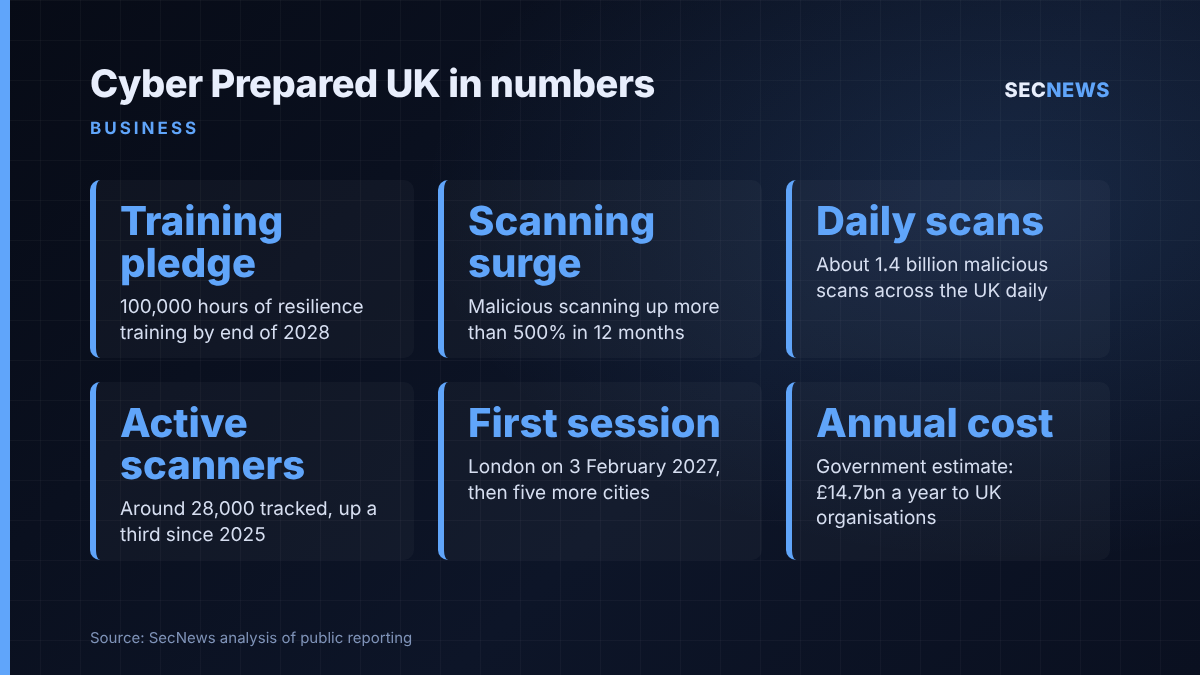
On 26 November 2026, BT Business announced Cyber Prepared UK, which it calls a first-of-its-kind programme to change how Britain’s smaller firms prepare for and handle cyber attacks. The plan has two parts. There will be in-person workshops in UK cities, and online modules that owners can fit around running a business. BT has committed to delivering 100,000 hours of resilience training by the end of 2028.
London hosts the first session on 3 February 2027, with Newcastle (11 February) and Birmingham (23 February) after it. Cardiff, Belfast and Edinburgh follow in March, and BT says more dates will be added through 2027. Sign-up runs through BT’s website. None of the coverage I have seen says whether places will be free or charged, so firms should check before budgeting.
BT has not run this alone. The National Cyber Security Centre, Microsoft, Anthropic, CrowdStrike, Samsung, Google, Fortinet, Xero, Immersive and TrustLayer are named as partners. Two business support groups, Small Business Britain and Be The Business, will help get the word out to owners. Lord Leong, the Minister for Small Business and Enterprise, gave a supporting statement. IT Pro reported that BT presents the scheme as part of the government’s wider push on national cyber resilience.
BT released threat figures from its own networks alongside the launch. It says malicious scanning, meaning automated probing of internet-facing systems for weak spots, has risen by more than 500% in the past 12 months. It estimates about 1.4 billion such scans hit UK targets every day, and it now tracks roughly 28,000 active malicious scanners, about a third more than in 2025. BT puts much of the rise down to criminals using AI and automation.
The detail
The training is built on simulated attacks rather than slides. BT says participants will work through scenarios ranging from social engineering to a full ransomware incident. As each scenario unfolds, its effects spread across customers, cash flow and day-to-day operations, and the participants have to make decisions under time pressure. Each business should come away with a clearer view of where it is exposed and a practical action plan built around the gaps the exercise uncovered.
The commercial picture matters here, and this is a business story as much as a skills one. BT Business says it protects more firms than any other UK network, and small and medium-sized enterprises are a core market for its connectivity and managed security products. Every vendor on the partner list also sells to that segment. That does not make the programme worthless, but owners should treat the sessions as education first and judge any sales follow-up on its own merits.
BT’s release cites the government’s Cyber Security Sectoral Analysis 2026, which estimates that malicious cyber activity costs UK organisations £14.7 billion a year. The NCSC, through Jonathon Ellison, its Director for National Resilience, used the launch to repeat its usual message. He said that “any business with digital assets is a potential target for attackers”, and that every business should get a Cyber Essentials certificate as proof that the basics are in place.
Why it matters for UK organisations
Small firms make up most UK businesses and a large share of the supply chains that bigger organisations depend on. Many have no in-house security staff. When those firms are hit, the effects spread: payroll bureaux, accountants and logistics providers all hold data or access that attackers can use against their customers.
The scanning figures need careful reading. They describe the volume of automated reconnaissance, not the number of successful breaches. A scan is not an intrusion. It is, however, an early warning sign. Mass scanning finds exposed remote access services, unpatched firewalls and forgotten test servers within hours of them appearing online, and AI tooling has cut the cost of turning that information into an attack. An old VPN appliance or open RDP port makes any firm a target, however small.
There is also a timing point for those planning budgets. Supply chain security is a recurring theme in the debate around the Cyber Security and Resilience Bill. Many larger customers already put Cyber Essentials and evidence of incident readiness into contracts. Practice in a simulated attack now gives a small firm something concrete to show when those questions arrive.
Expert view
I welcome anything that gets small business owners rehearsing an incident before it happens. In my experience, the gap that hurts smaller firms most is not a missing product. It is the first hour after something goes wrong. Nobody knows who to call, whether to shut systems down or where the backups really are. A simulation that forces those decisions is worth far more than another awareness video about phishing.
My reservations are about depth and follow-through. A single workshop builds awareness, but resilience comes from repeating the exercise and fixing what it uncovers. When we test smaller organisations, the same few issues come up again and again: shared admin accounts, multi-factor authentication missing on email and remote access, backups stored on the same network as the systems they protect, and edge devices that have not been patched in years. A simulation that ends in an action plan has value only if someone owns that plan and works through it.
Across the UK’s small business population, 100,000 hours is a modest figure, so the online material, and how well it serves non-technical owners, matters as much as the city events.
What to do now
- Book a place if you run or advise a small firm. Sign up early for the city nearest to you, and send the person who would actually make decisions during an incident, not only the IT contact.
- Check what you expose to the internet. Given the rise in scanning, list every internet-facing service, remove anything unused and patch the rest. This maps to the Cyber Essentials firewalls and security update management controls.
- Turn on multi-factor authentication everywhere it is offered, starting with email, remote access and finance platforms, under the Cyber Essentials user access control requirements.
- Test a restore from your backups and make sure at least one copy is offline or immutable, so ransomware cannot reach it.
- Write a one-page incident plan with names, phone numbers, your insurer’s hotline and your IT provider’s emergency contact, and keep a printed copy.
- Get Cyber Essentials certified if you have not already, as the NCSC recommends, and consider Cyber Essentials Plus if customers are asking for evidence.
Bottom line
Cyber Prepared UK is a useful, well-backed push to get small businesses practising incident response, and BT’s scanning data is a fair reminder of how cheap automated targeting has become. It will help most where firms treat the simulation as a starting point and fix what it exposes.
Sources
- BT Newsroom: BT launches nationwide cyber resilience drive as AI helps fuel 500% surge in malicious activity
- IT Pro: BT teams up with tech industry big hitters in UK cyber resilience drive
- SystemTek: BT launches Cyber Prepared UK to help small businesses fight rising cyber threats
- NewsForAgent: BT launches Cyber Prepared UK with 100,000 training hours