The UK’s data protection regulator is to have its culture, accountability and governance examined by an independent reviewer, Karon Monaghan KC, with findings due in the first quarter of 2027. For organisations that answer to the Information Commission, the more useful question is what the terms of reference say about how a regulator should be governed, and how little they touch enforcement.
What happened
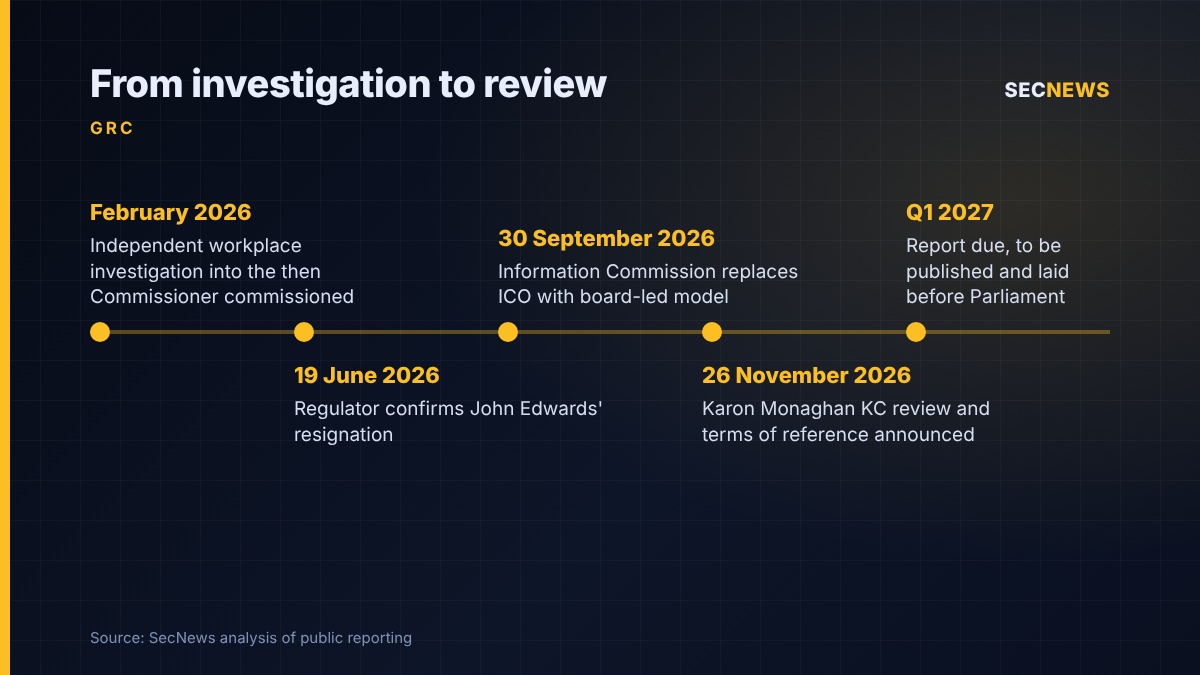
On 26 November 2026 the Department for Culture, Media and Sport (DCMS) and the Information Commission announced an independent review of culture, accountability and governance at the regulator. The review was commissioned by Lisa Nandy, the Secretary of State for Culture, Media and Sport, after consulting the Commission, and the terms of reference were agreed with the Commission’s Board. Barrister Karon Monaghan KC, a specialist in equality, employment, public law and human rights, has been appointed to lead it.
The background is the departure of the former Information Commissioner, John Edwards. According to the regulator, an independent workplace investigation commissioned in February 2026 found a case to answer and concluded that his conduct had not met the standard expected of someone in public office. The terms of reference note that he disputed some of those findings. The regulator confirmed his resignation on 19 June 2026. The government says the review was first announced in July and moved to DCMS after machinery of government changes.
Nandy said the review would look at “what is working, where things are falling short”, and what needs to change. Acting Chair Maggie Carver committed the regulator to following its recommendations. The FDA union, which says it helped shape the terms, welcomed the appointment and reported that 65% of members who responded to its recent survey saw bullying, harassment and discrimination as a serious problem at the regulator.
The detail
The earlier investigation looked at one person. This review examines the conditions around that person, and whether the organisation’s structures let problems develop or made concerns harder to raise.
There are four areas in scope:
- Cultural conditions and behavioural norms: whether expected standards of behaviour are set, communicated, modelled and upheld at every level.
- Raising concerns: how concerns are raised, heard, assessed and acted on, including concerns about senior figures, and whether people feel safe doing so.
- Accountability, leadership and governance: how these arrangements work in practice rather than on paper.
- Sponsorship: lessons for the relationship with DCMS, supporting challenge and accountability while preserving the regulator’s operational independence.
Three things are explicitly excluded. The review will not reopen the findings of the earlier investigation, will not make findings about the conduct or performance of named individuals, and will not consider the merits of regulatory decisions, enforcement action or the Commission’s statutory functions.
The process safeguards are detailed. Participation by current and former staff is voluntary and confidential, and the reviewer will see staff survey and bullying, harassment and discrimination data. A data handling protocol covering personal data, special category data, whistleblowing material and privileged material must be agreed before evidence gathering starts. The Register reports that the regulator has said settlement confidentiality clauses will not be used to stop people contributing. DCMS and the Board may flag factual inaccuracies in the draft report but cannot change its findings, and the final report is to be published in full, with any redactions explained, and laid before Parliament.
Why it matters for UK organisations
The first point is reassurance. The review is ring-fenced away from enforcement. Nothing in the terms suggests that live investigations, reprimands or penalty notices will be paused or revisited, and the regulator has said its focus remains on its statutory responsibilities. Nobody should read this as a period in which the regulator is distracted or softer.
The second point is timing. The Information Commission only replaced the ICO on 30 September 2026, moving from a single commissioner to a corporate model with a seven-member non-executive Board and an interim chief executive. The review is explicitly meant to inform that new board as it builds its arrangements. Better internal challenge should, in principle, produce more consistent and defensible decisions, which matters to anyone facing an investigation under the Data (Use and Access) Act regime.
The third point is the mirror. The four scope areas read almost exactly like the questions regulators ask of the organisations they supervise: are standards set and modelled from the top, can staff raise concerns about senior people safely, and does governance work in practice? Boards that are preparing for the Cyber Security and Resilience Bill, or for operational resilience scrutiny from financial regulators, are being asked to evidence the same things.
Expert view
In my experience, security failures are rarely purely technical. When we test an organisation and find a domain admin account nobody owns, or a critical finding sitting unremediated for a year, the root cause is usually cultural: someone knew, but did not feel able to escalate it, or escalated it and saw nothing happen. That is precisely the second scope area in these terms of reference, and it is good to see it written down so plainly for a regulator.
I would also flag the sponsorship strand. Independence from government is central to how a data protection regulator is trusted, both domestically and by international partners. The terms try to square that circle by limiting DCMS to a single commissioning act with no continuing power of direction, and by recording any refused requests to widen scope in the final report. That design is worth copying for internal audit functions that report to the executives they challenge.
What the review cannot do is rule on whether past enforcement decisions were right. Anyone hoping it will become a vehicle for relitigating a fine or reprimand will be disappointed, and I think that is correct.
What to do now
- Carry on as normal with the regulator. Keep breach notification timelines, records of processing and remediation plans current. Treat any open ICO matter exactly as before.
- Read the terms of reference as a self-assessment. Map the four scope areas against your own board reporting on security and data protection. Ask whether your behavioural standards are modelled by leadership, not just written in policy.
- Test your speak-up route for security concerns. Check whether an engineer can raise a concern about a senior stakeholder’s risk acceptance without going through that stakeholder, and whether reports are tracked to closure.
- Review settlement and NDA practice. Make sure confidentiality clauses do not stop staff reporting security or data protection concerns to regulators or reviewers.
- Tie governance to basic controls. Cyber Essentials controls such as user access control and security update management give boards concrete metrics, such as dormant admin accounts and patch age, to ask about each quarter.
Bottom line
This is a governance review of the regulator, not of its decisions, and it should not change how organisations deal with the Information Commission in the meantime. Its terms of reference are still a useful checklist for any board. If the body that enforces data protection is being asked whether staff can safely challenge senior leaders, your own security function deserves the same question.
Sources
- GOV.UK: Independent review of culture, accountability and governance at the Information Commission – terms of reference
- GOV.UK: Independent review of culture at the Information Commission launched
- ICO: ICO and DCMS announce launch of independent review following former Commissioner resignation
- The Register: UK privacy watchdog faces probe into its workplace culture
- PublicTechnology: Ministers launch independent review into culture at ICO
- FDA: FDA welcomes independent review of accountability and governance at the Information Commission