ThreatBook has pulled the open-source edition of CyberStrikeAI, one of the most widely deployed agentic AI penetration testing frameworks, from GitHub after attackers adopted it. Deleting the official repository will not switch off the copies already running, and UK security teams now face a less trustworthy landscape of unofficial forks.
What happened
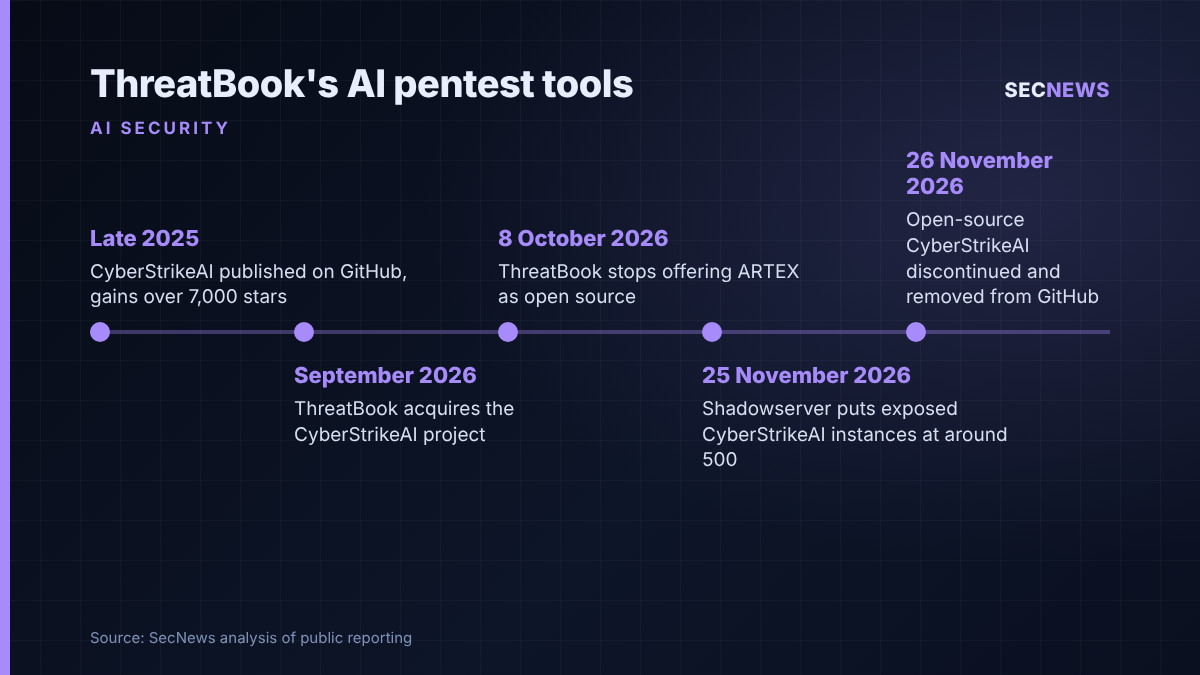
On 26 November 2026, ThreatBook, a security vendor based in Singapore and Hong Kong, announced that it was ending the open-source version of CyberStrikeAI with immediate effect. The platform and its associated projects have been permanently deleted from GitHub and other open-source communities. Its reason: attackers worldwide have been using AI pentest tools, CyberStrikeAI included, to attack faster and at greater volume, and as owner it feels obliged to prevent abuse.
CyberStrikeAI first appeared on GitHub in late 2025. Infosecurity Magazine reports that it gathered more than 7,000 stars there, and ThreatBook itself describes it as one of the most popular AI pentest tools in the world, with internet scanning pointing to several thousand live installations. ThreatBook acquired the project in September 2026.
This is the second framework the company has withdrawn from open source. ThreatBook also owns ARTEX, which it stopped offering openly on 8 October 2026. It is not leaving the market, though. Closed-source “Pro” editions of both tools, ARTEX Pro and CyberStrikeAI Pro, remain on sale through a product called RedAgents. ThreatBook says access is limited to verified enterprises that hold valid authorisation for the networks they test, and that it will cut off anyone who misuses it. Anyone still wanting the open-source code has been told to treat forks that appear elsewhere with suspicion.
The technical picture
CyberStrikeAI belongs to a class of software now usually called agentic offensive frameworks. A large language model plans the engagement, runs reconnaissance and exploitation steps, reads the results and decides what to try next, while the operator simply supplies a target scope. The techniques are rarely new; the tempo and the low skill barrier are.
The scale of deployment is visible from the outside. The Shadowserver Foundation, which Infosecurity Magazine describes as UK government-funded, recently began daily internet-wide scans for 15 such frameworks. Its 25 November report counted roughly 4,200 publicly exposed instances on 23 November, and it puts CyberStrikeAI at around 500 of the instances it sees. Its honeypots also logged more than 10,000 events from over 80 framework-running IP addresses between 9 and 23 November, a handful of them CyberStrikeAI. The probing focused on VPN and remote access gateways, CI servers such as Jenkins, web applications and exposed .env files holding secrets, mostly in short bursts, peaking at dozens of requests a minute.
There is also evidence of targeted criminal use. According to Infosecurity Magazine, India’s CERT-In warned last month that a group it tracks as Crafty Falcon had been hitting financial and cryptocurrency organisations with several AI-powered tools, CyberStrikeAI among them.
The key technical point is that removing a repository does not remove a capability. The code sat publicly on GitHub for around a year, and anyone who cloned it still has it. Shadowserver’s figures make the point well: ARTEX made up about 70% of exposed framework instances on most days in the week to 23 November, more than six weeks after ThreatBook withdrew it from open source.
Why it matters for UK organisations
Three UK audiences should take notice. For defenders in general, withdrawal changes very little. Criminal operators who already run CyberStrikeAI keep their copies. Planning should assume that machine-speed reconnaissance and exploitation against internet-facing systems is now normal.
Second, in-house red teams, consultancies and IT departments that adopted CyberStrikeAI legitimately are now running software with no official upstream and no maintained fixes. These platforms hold scope documents, findings, credentials harvested during testing and LLM API keys, so an exposed or unpatched console is a valuable target in its own right. Shadowserver’s honeypot data shows framework operators already hunting for the credential files that AI coding assistants use.
Third, buyers and users must consider the supply chain. A popular offensive tool with no official source is an ideal lure: a trojanised fork that promises “the original CyberStrikeAI” will be attractive to exactly the people who run it with elevated privileges on testing infrastructure. ThreatBook’s RedAgents checks also echo a basic UK legal point: under the Computer Misuse Act, written permission for in-scope systems separates a test from an offence.
Expert view
I welcome the decision, but I would not overstate it. Moving a popular tool from open source to a vetted paid offering is partly safety and partly business model. The press release gives no detail on how customer authorisation is checked, so nobody outside can yet judge it.
In my experience, defensive teams tend to react to a takedown with relief, as if the problem has been solved. It has not. Released offensive tooling behaves like a leaked exploit: it gets forked, repackaged and resold. Treat this as a prompt to check your estate and suppliers, not as reduced risk.
The encouraging news is that these frameworks are noisy. When we test environments with good logging, bursts of automated requests that cycle quickly through techniques stand out clearly. Organisations that rate-limit, alert on rapid stage-to-stage progression and keep their internet-facing footprint small are in a far better position than those relying on signatures.
What to do now
- Find any CyberStrikeAI in your estate. Ask security, IT, development teams and testing suppliers. Subscribe to Shadowserver’s free daily network reports and look for device_type set to ai-attack-framework in the Device Identification report. Treat any instance nobody can account for as a compromise and isolate it.
- Lock down sanctioned installations. Keep consoles off the public internet, behind a VPN or allow-list, with strong authentication and MFA. This maps directly to the Cyber Essentials firewall, secure configuration and user access control controls.
- Do not pull random forks. If you must keep using the open-source version, freeze on a copy you already hold and have verified, record its hash, and plan a migration to a supported tool. Treat any new “official” mirror as untrusted.
- Rotate secrets the tool has touched. Replace LLM API keys, cloud credentials and any client credentials stored on testing platforms, and keep .env files out of web roots.
- Tighten patching for internet-facing systems. Cyber Essentials requires high and critical fixes within 14 days; for VPNs, remote access gateways and CI servers, aim for much faster.
- Tune detection for machine speed. Alert on single sources moving from scanning to exploitation to credential access within minutes, apply rate limiting on web applications and APIs, and consider blocking IP addresses that Shadowserver’s honeypot reports label as running attack frameworks.
- Question your pentest suppliers. Ask which AI frameworks they use, where they obtain them, how consoles are hosted and how your data and credentials are protected.
Bottom line
ThreatBook’s withdrawal of CyberStrikeAI is a responsible step, but it takes no copies out of attackers’ hands. UK organisations should use it as a trigger to audit for the tool, secure any legitimate deployments, avoid unvetted forks and build defences on the assumption that agentic attack frameworks are here to stay.
Sources
- ThreatBook: ThreatBook Discontinues CyberStrikeAI (Open Source Version)
- Infosecurity Magazine: CyberStrikeAI Creator Shuts Down Open-Source AI Offensive Framework
- DigitalToday: ThreatBook halts open-source version of AI penetration testing tool CyberStrikeAI
- Shadowserver Foundation: Agentic AI Attack Frameworks in the Wild: What Our Scans and Honeypots Show