US prosecutors have charged the co-founder of a ransomware recovery firm that told victims never to pay, alleging he quietly bought decryption keys from attackers and resold them at a markup. For UK organisations, the case shows why the firm you call during an incident needs as much scrutiny as the attacker does.
What happened
A federal grand jury in Rhode Island has indicted Juan Ricardo Palacio Escobar, a 52-year-old Colombian national and co-founder of the Florida business Ransomwarehelp.com, on three counts of wire fraud. The US Department of Justice confirmed the charges on Wednesday 25 November 2026. Together the counts carry a maximum of 60 years in prison. Palacio was arrested in Las Vegas on 22 October, moved to Rhode Island and released on pretrial bond on 20 November. He has not been convicted, and the claims against him remain allegations.
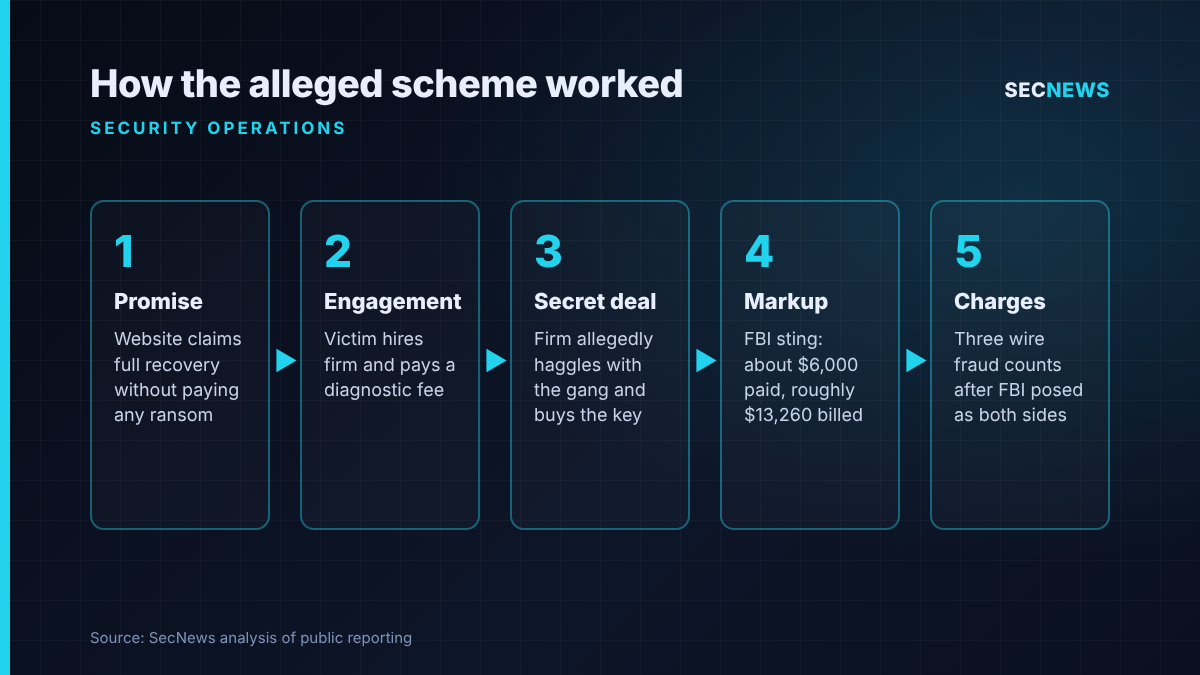
The company, which KrebsOnSecurity says had been trading for around six years, sold itself as the ethical alternative to paying criminals. Its website urged victims not to pay, claimed proprietary cryptographic tools could restore all of their data and said the firm never paid or brokered ransoms. Prosecutors allege Palacio instead contacted the attackers, bought the decryption key and billed the victim far more than he had paid.
The FBI tested this in June with a sting in which it played both parts: a victim company and a fictitious ransomware group. According to the government, Palacio again told the “victim” that his firm never negotiated or paid. He then approached the fake gang, haggled the price down, paid about $6,000 in Bitcoin for the key and charged the undercover company roughly $13,260 for his supposed decryption service. KrebsOnSecurity, citing the indictment, puts the total invoice at $16,010 once a $2,750 diagnostic fee is included. FBI agent Ted Docks called Palacio “the proverbial wolf in sheep’s clothing”.
How it works
The alleged scheme exploits an information gap every incident responder will recognise. Modern ransomware cannot be brute-forced. Unless a malware flaw or a key seized by law enforcement yields a free decryptor, the attacker’s key is the only route back to encrypted files. A firm promising guaranteed decryption without contacting the criminals is either reselling one of those rare public tools or, as alleged here, quietly buying the key.
KrebsOnSecurity spoke to Paul Ihme, co-founder of the security firm Soteria, who described a 2024 case involving a small accounting practice hit by LockBit. According to Ihme, Ransomwarehelp asked for unrestricted remote access through AnyDesk. It quoted $438,880 for a “decryption” process padded with technical-sounding line items. Soteria found only one ransom note on the network, recovered from a backup snapshot, and on joining the LockBit chat discovered someone had already been negotiating for days. Ihme believes the remote access was used to delete the notes so the victim could not contact the gang directly. That account has not been tested in court.
This is not an isolated case. The Record notes that the DoJ charged the owner of another Florida recovery firm with a similar scheme last month. KrebsOnSecurity reports that MonsterCloud chief executive Zohar Pinhasi was charged in early October, with charging documents claiming he paid gangs $8m while charging customers $19m.
Why it matters for UK organisations
These are US cases, but the market is global. UK small businesses search for help in the same panic, and a search for “ransomware recovery” returns firms based anywhere. According to Ihme, the firm went after those least able to judge technical claims: small businesses with little technical knowledge and nobody advising them.
There is also a legal issue that the US case brings into focus. Guidance published in May 2024 by the NCSC with the insurance bodies ABI, BIBA and IUA warns that a payment may be unlawful if it reaches a UK-sanctioned entity or jurisdiction. It also says the ICO does not treat paying criminals as mitigation and will not reduce a penalty because of it. If an intermediary pays secretly in your name, you lose the chance to carry out sanctions checks, document the decision or involve your insurer. You may also have told your board, and the ICO, that no ransom was paid when one was.
Policy points the same way. The Home Office consulted in early 2025 on legislation to increase incident reporting and reduce ransomware payments from the UK, publishing its response on 22 July 2025. Organisations should check the latest Home Office position rather than assume a reporting or payment regime is already in force. Whatever its final shape, any regime built on victims reporting payments fails if intermediaries can pay without their knowledge.
Expert view
In my experience, the worst decisions in a ransomware incident are made in the first six hours, before anyone has slept or called the insurer. That is the window this kind of operator exploits. Ihme’s summary of the claims to Krebs was blunt: if they were true, “this guy would be a billionaire”.
The warning signs are clear once you know them: guaranteed full recovery, proprietary decryption for current ransomware families, demands for broad unsupervised remote access before scoping, and reluctance about you keeping the ransom note or calling law enforcement. Legitimate responders say plainly when the attacker’s key is the only route, explore backups and free decryptors first, and document any payment openly, with sanctions screening.
Negotiation itself is not the problem. Experienced negotiators can buy time and reduce demands. The problem is concealment, and the fix is procedural: decide who you trust before you need them.
What to do now
- Put an incident response retainer in place before an incident. Choose an established cyber incident response (CIR) company of the kind the NCSC guidance points to, ideally one on your insurer’s panel, and keep the contact details offline.
- Read your cyber policy. Many require early notification and panel firms; going outside the panel can risk cover and removes a layer of vetting.
- Write the ransom decision into your plan. Name who can authorise engagement with attackers, require sanctions checks, and record every decision offline, as the NCSC, ABI, BIBA and IUA guidance recommends.
- Preserve the evidence. Keep copies of ransom notes, chat portal identifiers and logs. No third party should be allowed to remove them.
- Control third-party remote access. Under the Cyber Essentials user access control and secure configuration requirements, give responders named, time-limited, logged accounts rather than an unmanaged AnyDesk session, and revoke access when the work ends.
- Test your backups. Make sure they are offline or immutable and restore-tested, so that paying is never the only option. Ask law enforcement and your responder whether a free decryptor exists before anything else.
- Report the incident. Use the gov.uk incident signposting service to find out who to notify, and engage the NCSC for significant incidents.
Bottom line
If the allegations are proved, Ransomwarehelp sold victims a promise that ransomware cryptography cannot keep, and hid the payments that made its “recoveries” possible. UK organisations should treat their choice of recovery partner as a security control. Vet the firm in advance, keep the ransom decision in your own hands and make sure any payment is visible to your board, your insurer and the authorities.
Sources
- The Record: Florida ransomware recovery CEO indicted for allegedly paying hacker ransoms
- KrebsOnSecurity: CTO of ‘RansomwareHelp’ Indicted for Wire Fraud
- 404 Media: To Catch a Ransomware Scammer, FBI Posed as Both Victim and Attacker
- NCSC: Guidance for organisations considering payment in ransomware incidents
- GOV.UK (Home Office): Ransomware: proposals to increase incident reporting and reduce payments to criminals