Juniper has confirmed that attackers are exploiting CVE-2026-103406, a critical root-level command injection flaw in Session Smart Conductor, the box that orchestrates its Session Smart SD-WAN routers. The patch has been out since 28 October, so any UK organisation or managed service provider still running an unpatched Conductor has run out of excuses.
What happened
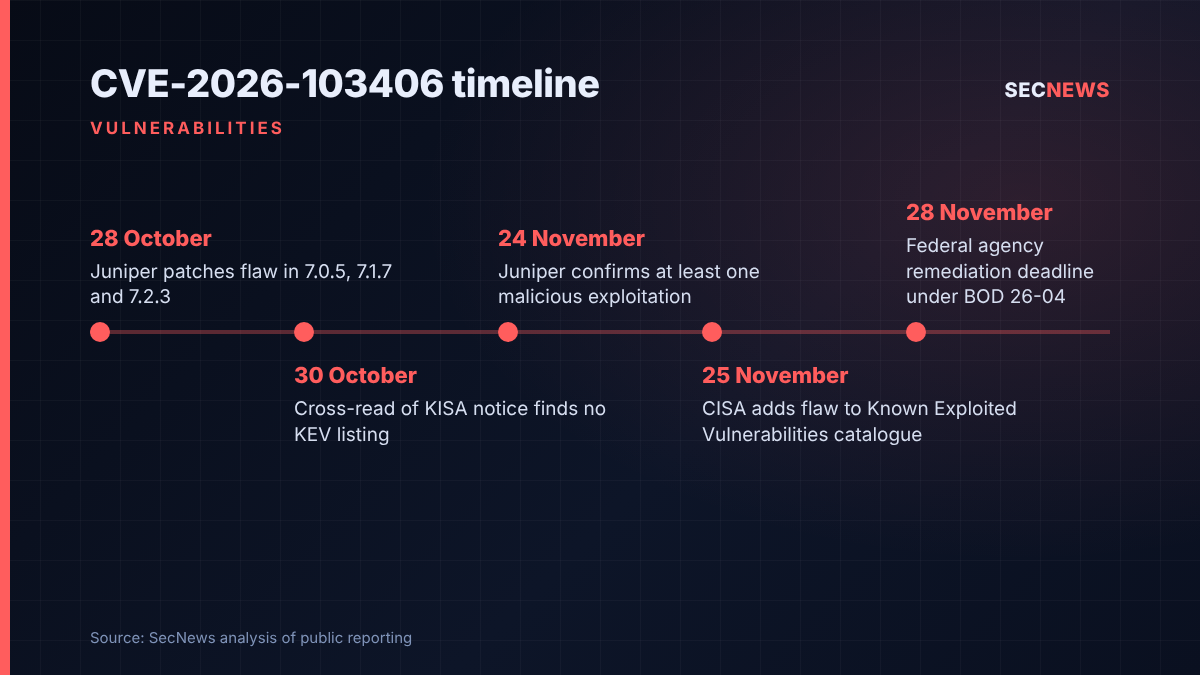
On Tuesday 24 November 2026, Juniper Networks, now part of Hewlett Packard Enterprise, revised its security advisory for the Session Smart product family to state that CVE-2026-103406 is being abused. The updated wording says at least one case of malicious exploitation has been reported to the Juniper SIRT, and it urges customers to move to a fixed release without delay and to mitigate in the meantime.
A day later, on 25 November, the US Cybersecurity and Infrastructure Security Agency (CISA) placed the flaw in its Known Exploited Vulnerabilities (KEV) catalogue. Under Binding Operational Directive 26-04, US federal civilian agencies were given just three days to remediate, with a due date of 28 November. The same KEV update also added several other products, including the Mitel MiCollab flaws we reported on 26 November, a Vates Xen Orchestra authentication bypass and three Danfoss refrigeration controller issues.
Neither Juniper nor CISA has said who is behind the activity, how many organisations have been hit or what the attackers did after gaining access. The fix is not new: Juniper released it on 28 October 2026 as part of a bulletin covering 18 vulnerabilities across Session Smart Router and Session Smart Conductor.
The technical picture
Session Smart Conductor is the central management and policy engine for Juniper’s Session Smart Router and the heart of its software-based SD-WAN offering. Routers register with the Conductor using Salt, the open-source configuration management framework, in which each managed router acts as a “minion” and presents a unique minion ID to the Conductor, which plays the role of Salt master.
The weakness sits in the Conductor’s AutomatedProvisioner service. According to the CVE record, a remote attacker can send a crafted Salt minion ID that the service fails to sanitise before it reaches an operating system command, so the attacker’s input runs with root privileges. It is classed as CWE-78, OS command injection, and scored 9.8 under CVSS 3.1 with a vector requiring no authentication, no user interaction and low attack complexity.
A cross-reading by the Korean site Braindetox of a notice on the October advisory from KISA, the Korea Internet and Security Agency, notes that this is the only one of the ten CVEs listed that affects Conductor alone, and one of only two rated 9.8. When Braindetox checked the KEV list on 30 October, none of the ten had been flagged as exploited. That has now changed for this one.
Fixed releases are 7.0.5, 7.1.7 and 7.2.3 and later, which, on Braindetox’s reading of the KISA table, also close the other Session Smart flaws in that notice. The CVE record states that no workarounds exist, so the options are to patch or to restrict who can reach the service.
Why it matters for UK organisations
SD-WAN controllers occupy a privileged position. A Conductor holds the configuration, policy and often the credentials for every branch router it manages, and root on that host is effectively the keys to the wide area network. For UK retailers, banks, healthcare providers and public bodies with large branch estates, a compromise here is not a single-device problem but a route into every site.
Managed service providers and telecoms operators deserve particular attention. Many UK organisations buy SD-WAN as a managed service, meaning the Conductor may sit in a provider’s data centre and serve many customers at once. A provider that has not applied the October fix creates exposure across its entire customer base. With the Cyber Security and Resilience Bill set to bring managed service providers into the UK’s NIS regime, how quickly providers act on KEV-listed flaws in their management platforms is likely to come under closer regulatory scrutiny.
There is also a timing issue. The patch is a month old, yet exploitation has only just been confirmed. Organisations that triaged the October bulletin as “critical but not exploited” and pushed it into the next maintenance window are exactly the ones now at risk.
Expert view
In my experience, management planes are the soft underbelly of most enterprise networks. When we test SD-WAN and firewall estates, the controller is usually reachable from far more places than the design documents suggest, because remote routers have to be able to call home and nobody narrows that exposure afterwards. A flaw that fires during router registration is especially awkward, because the registration path is the one interface that has to accept connections from devices that are not yet trusted.
The pattern here is familiar. A vendor fixes a batch of 18 bugs, one of them stands out at 9.8, and four weeks later exploitation is confirmed. Treating “no known exploitation” as a reason to wait is a gamble that keeps losing.
I would also caution against assuming that patching ends the matter. If a Conductor was reachable and unpatched at any point since late October, the right question is whether someone has already been in. Root access on a central controller is the kind of foothold an attacker will use to plant persistence, harvest credentials or push changes to downstream routers, and none of that is undone by an upgrade.
What to do now
- Identify every Conductor. Confirm whether you, or any managed provider acting for you, run Session Smart Conductor, and record its version.
- Upgrade immediately. Move to 7.0.5, 7.1.7, 7.2.3 or later. Under Cyber Essentials security update management, a critical, actively exploited flaw should be fixed well inside the 14-day limit, and this one has been patchable for a month.
- Restrict reachability. Limit access to the Conductor’s management and provisioning services to known router addresses and trusted administrative networks, in line with the Cyber Essentials firewall and secure configuration controls.
- Hunt for compromise. Review Conductor logs for unexpected router registrations or odd minion IDs, look for unfamiliar processes, accounts, scheduled tasks or outbound connections, and check whether router configurations have changed without an approved change record.
- Rotate secrets. If a Conductor was exposed and unpatched, treat its stored credentials, keys and certificates as compromised and rotate them after rebuilding or verifying the host.
- Patch the routers too. The same fixed versions close the other October Session Smart Router flaws, so bring the whole estate up to date at once.
- Track KEV. Even though BOD 26-04 binds only US federal agencies, the KEV catalogue is a sound prioritisation input for UK teams, and new entries should trigger a same-day check of your own estate.
Bottom line
CVE-2026-103406 hands an unauthenticated attacker root on the device that runs your SD-WAN, and it is now being exploited. The fix has been available since 28 October. If you, or your provider, have a Session Smart Conductor that is not on 7.0.5, 7.1.7, 7.2.3 or later, upgrade it today, lock down who can reach it and check carefully for signs that someone got there first.
Sources
- SecurityWeek: Critical Juniper Session Smart Conductor Flaw Exploited in Attacks
- The Hacker News: Hackers Exploit 10 Vulnerabilities Across Mitel, Juniper, Vates, and Danfoss Products
- OpenCVE: CVE-2026-103406 record (includes CISA KEV listing and Juniper advisory JSA112183 reference)
- Braindetox: Juniper Session Smart: 10 CVEs, Fixes 7.0.5, 7.1.7, 7.2.3 (KISA notice cross-read)