Two US businesses owned by London-headquartered Barclays have disclosed separate data breaches that together affect more than 819,000 American consumers. One hit Best Egg, a lender Barclays bought this year, and the other hit a card application tool run by Barclays Bank Delaware.
What happened
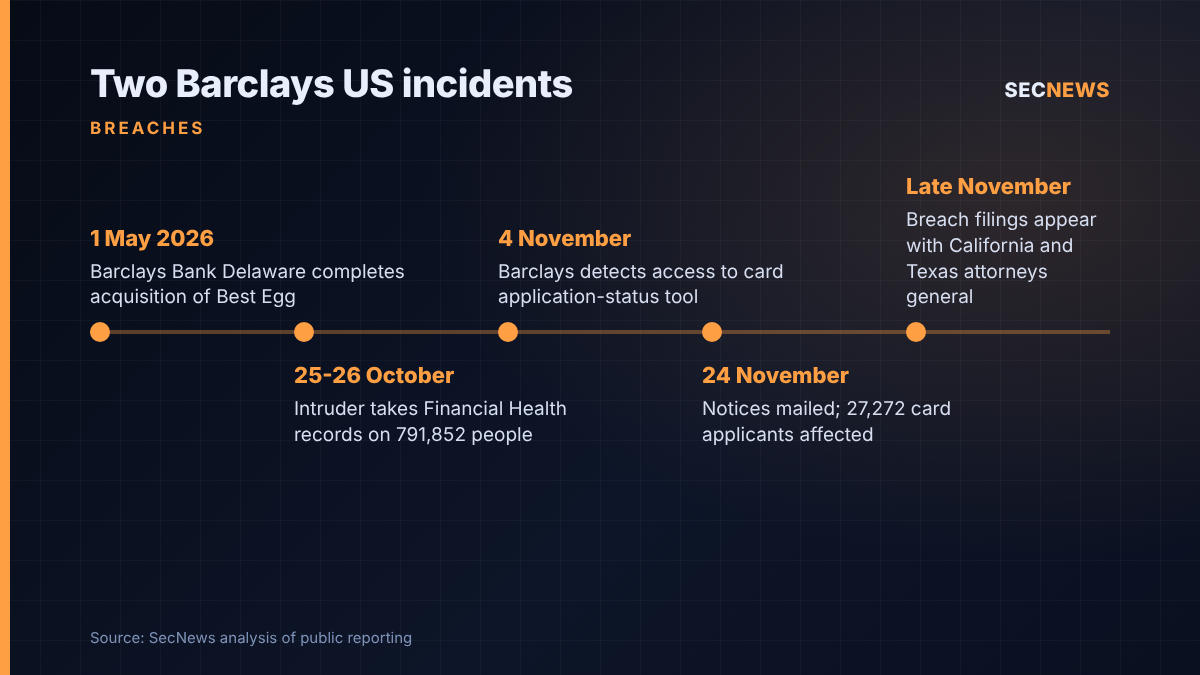
Barclays is handling two unrelated incidents in its US consumer business, both revealed through state breach notification filings in the week of 24 November 2026. Every person affected so far is a US consumer. Nothing in the disclosures mentions UK customers or UK systems.
The larger incident hit Best Egg, an online personal lender. Barclays Bank Delaware completed its purchase of Best Egg on 1 May 2026. Best Egg told the Texas attorney general that 791,852 people were affected. The intruder got in through Best Egg Financial Health, a free budgeting app that pulls together a user’s current, savings and card balances from other banks. According to the filing, access ran from 25 October to 26 October. Best Egg says it noticed suspicious activity on 26 October and switched off the affected system the same day.
The stolen records hold names, dates of birth, contact details and Social Security numbers, plus the bank account numbers borrowers had used to repay Best Egg loans. App users who never borrowed from the firm are also affected. Best Egg says credentials for linked external accounts were not exposed and that no supplier was involved. It has not said how the intruder got in. Cross River Bank and Column N.A., the banks that originate Best Egg loans, both say their own systems were untouched.
The second incident is smaller. Barclays Bank Delaware, which trades as Barclays US Consumer Bank, issues co-branded credit cards through retail and travel partners. Its notice to affected people, dated 24 November and filed with the California attorney general, says it detected suspicious activity on 4 November on the online service that lets applicants check where their card application stands. An unauthorised third party accessed that system and took applicant records containing names, contact information, dates of birth and Social Security numbers. The Texas filing counts 27,272 people, 1,064 of them Texans. It gives 4 November as the end date and no start date.
Barclays says existing card accounts were not affected. CyberInsider, citing American Banker, reports that the bank regards the two incidents as unrelated. Notices went out on 24 November, and both firms are offering 24 months of Experian IdentityWorks monitoring and identity restoration, with enrolment open until 31 March 2027. Barclays says both incidents have been reported to law enforcement and banking regulators.
The technical picture
Neither firm has explained the method, so any account of technique is inference. The shape of each incident still tells defenders a lot.
The striking detail concerns the application-status tool. According to The Paypers and Beinsure, applicants identify themselves with a surname, the final four Social Security digits and a ZIP code. Yet the records taken included full Social Security numbers, and Barclays has declined to say why. A lookup that only needs to answer “approved, declined or pending” had full identity data within reach. Either the service could query far more than its job required, or the attacker reached the data store behind it. Three weak, partly guessable inputs guarding a full record is a design that invites enumeration unless rate limiting and anomaly detection are tight.
Best Egg is a different problem. The target was a finance aggregation app, a product built to concentrate sensitive data from many sources. The firm’s statement that no third party was involved points to its own platform or credentials rather than a supplier. Detection within about a day is respectable, yet nearly 800,000 records still left in that window.
Why it matters for UK organisations
On the facts available, UK Barclays customers are not affected. Both incidents sit in US entities and involve US identifiers. UK readers should treat any unsolicited message claiming otherwise as likely phishing.
The wider lesson for UK boards concerns acquisitions and overseas subsidiaries. Best Egg had been part of the group for under six months when it was breached. The first year after a deal is when inherited security debt is most exposed: control frameworks are not yet aligned, the acquired firm’s logs may not reach the parent’s security operations centre, and ownership of risk is often unclear. UK organisations buying abroad should expect the parent’s name in the headline when something goes wrong, wherever the data sits.
The status-checker flaw has a direct UK parallel. Lenders, retailers, insurers and public bodies here all run “check your status” or “track your order” pages that accept a few low-entropy details. They are built quickly and rarely get the scrutiny given to the main login journey. A similar exposure of UK identity data would very likely be reportable to the ICO under UK GDPR.
Expert view
In my experience, lightweight lookup endpoints are among the most reliably fruitful targets on a web application test. They are designed to be frictionless, sit outside the main authentication flow, and developers tend to assume that a feature returning only a status cannot leak much. That assumption fails when the backend returns a whole record and the front end merely chooses what to display. When we test these features, we inspect what the API actually sends back, not what the page shows.
Full Social Security numbers being reachable from a tool keyed on four digits suggests data minimisation may not have been enforced at the service boundary. If so, that is a design decision rather than bad luck. I would also want to know whether the missing start date reflects thin logging, because that is often why investigators cannot rebuild a timeline.
A breach soon after an acquisition is not proof of negligence. It should, though, make every acquirer ask whether they tested what they bought before attaching their brand to it.
What to do now
- Inventory public lookup endpoints. Status checkers, order trackers, quote retrievers and reset flows belong explicitly in penetration test scope.
- Minimise data at the service layer. APIs should return only the fields a feature needs, never a full record for the interface to hide. This supports the Cyber Essentials secure configuration control.
- Throttle and watch for enumeration. Apply rate limits, bot detection and alerting to any endpoint taking guessable inputs such as partial identifiers and postcodes.
- Bring acquisitions into scope on day one. Assess security at or before completion, feed the new firm’s logs into group monitoring, and align access control and patching with your Cyber Essentials baseline.
- Check log retention. Make sure you could establish when an intrusion began, not just when it was noticed.
- Prepare for brand-led phishing. Tell customers how you will and will not contact them after a breach headline.
Bottom line
These are US breaches affecting US consumers, and nothing disclosed so far suggests UK Barclays customers are involved. The lessons still travel: a recently acquired subsidiary had records on nearly 800,000 people taken in about a day, and a simple status checker exposed identity numbers it never needed. UK organisations should examine their own lookup pages and latest acquisitions before an attacker does.
Sources
- California Attorney General: Barclays Bank Delaware notice of data breach (24 November 2026)
- The Paypers: Barclays’ Best Egg discloses data breach affecting 792,000 people
- CyberInsider: Barclays-owned Best Egg suffers data breach impacting 792,000 customers
- Beinsure: Best Egg data breach exposes 792K customers as Barclays reports separate cyber incident