New CREST research suggests AI is changing what clients pay a threat-led penetration testing provider for, as well as how the work gets done. Providers expect buyers to add AI clauses to contracts, and they expect stronger demand for testers who can check what the machines produce.
What happened
CREST, the not-for-profit accreditation body for the technical security industry, has published AI and the Future of Threat-Led Penetration Testing: Capability, Control and Credible Assurance. Dated November 2026 and reported by Help Net Security on 27 November, it combines a company-level survey of 26 threat-led penetration testing (TLPT) providers with two industry roundtables that focused mainly on financial services.
Fourteen respondents work mainly on commercial engagements and twelve on regulated or scheme-based tests, with headquarters in around ten countries. CREST stresses that the sample is small.
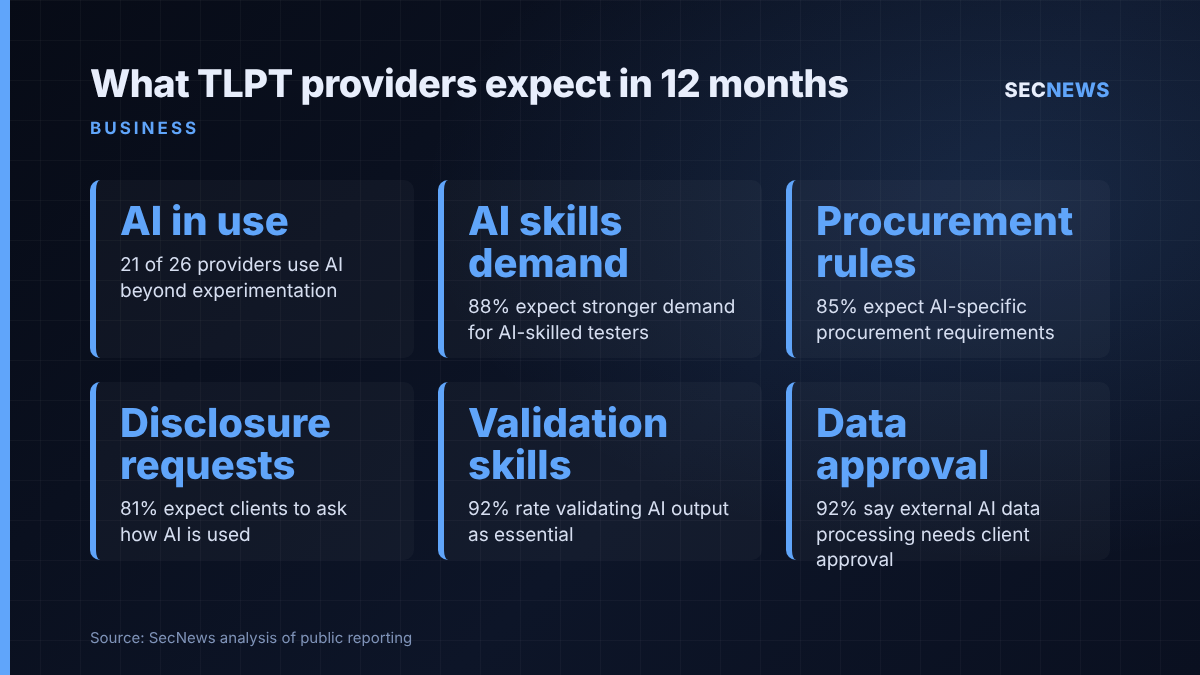
The headline numbers point one way. Of the 26 providers, 21 already use AI beyond experimentation, and 17 expect AI to support 40 per cent or more of their TLPT tasks within a year. Looking 12 months ahead, 88 per cent expect stronger demand for testers with AI-specific skills, 85 per cent expect AI-specific procurement requirements, and 81 per cent expect clients to ask them to disclose how they use AI.
The detail
For anyone running or buying a testing practice, the market findings matter most. Some financial institutions are building more testing capability themselves, and CREST openly asks what a client is paying an outside firm for once it can produce its own tooling. Its answer: independent challenge, inventive scenario design, sound decisions when the picture is unclear, and a view across many organisations.
Skills are the second pressure point. Validating AI-generated technical output was rated essential by 92 per cent of respondents, secure handling of data used with AI by 85 per cent, and both human judgement and an understanding of AI failure modes by 81 per cent. Manual exploitation still scored 73 per cent. CREST also notes that AI can generate advanced tooling faster than testers gain the experience to review it.
The third pressure is cost. Building capability gets cheaper, but running it to a high assurance standard still needs compute, hosting, monitoring and controls, which roundtable participants saw as a burden for smaller firms. CREST also warns that shared models and toolchains could give apparently different providers the same blind spots.
The disclosure and approval figures read like a draft of tomorrow’s statement of work. Asked which uses most clearly need explicit client approval, 92 per cent picked passing client data to an outside or cloud AI service, and 62 per cent chose autonomous testing actions. Just one respondent put naming the AI model among its top three disclosures, against 81 per cent for external data processing. None of the 11 regulated providers that answered permits autonomous execution, and only one commercial firm allows it.
Why it matters for UK organisations
The UK has one of the most mature threat-led testing markets anywhere, with regulator-led schemes such as the Bank of England’s CBEST alongside a large commercial red teaming sector, much of it CREST accredited. A shift in what clients value will reach UK consultancies early.
For UK buyers, especially banks, insurers and their critical suppliers, the message is that a procurement refresh is coming. Providers expect AI clauses to become far more common. The report suggests they should cover where client data is processed and stored, retention, whether data is used for training, subcontractors, and whether an approval still holds when a provider changes a model or integration mid-engagement.
For UK providers, the workforce problem is acute. The industry already struggles to grow senior testers, and the report’s finding that tooling can outpace the experience needed to supervise it points to a squeeze in the middle of the career ladder. Firms that stop hiring juniors because AI drafts reports may later lack people able to validate its output. CREST has also given buyers a way to compare providers: its optional AI-Enabled Penetration Testing accreditation module, added in July 2026, had certified its first cohort of ten firms by September, according to Infosecurity Magazine.
Expert view
The report confirms what many of us in the testing trade have suspected for a year. AI is not making the tester redundant. It is moving the tester’s value up the stack. Reformatting scanner output never justified senior day rates, and AI is commoditising that layer fast. What clients pay for now is choosing the right threat, knowing when a generated attack path is plausible but irrelevant, and standing behind a conclusion in front of a board or a regulator.
In my experience, the providers who struggle in a market shift like this are rarely the ones with weaker tools. They are the ones who cannot explain their process. CREST’s data on disclosure supports that view: providers think clients care far more about what happens to their data and who authorised each action than about which model was used. Nick Benson, CREST’s chief executive, was quoted by Help Net Security as saying that AI “is already changing how it is delivered”. The commercial winners will be firms that can evidence that change rather than market it.
The in-house trend deserves attention, though I would not overstate it. What is new is how cheaply AI lets banks produce bespoke tooling. Independence, cross-sector perspective and the willingness to challenge a client’s assumptions cannot be generated, and those are what an external provider must sell.
What to do now
- Buyers: update testing contracts. Require disclosure of where AI is used across the engagement, where client data is processed, and what human approval points exist. Make sending data to external AI services and any autonomous action subject to explicit written approval.
- Buyers: ask for an evidence trail. The final report should trace each conclusion back to the agreed threat, the authorised scenario, the activity performed and the evidence observed. It should also state clearly what was not tested.
- Providers: write down your AI governance. Set out, for each engagement, AI’s role, its data access, its authority and when testers intervene. Treat a model or integration change as a change-control event that needs fresh approval.
- Providers: protect the skills pipeline. Keep investing in manual exploitation and validation skills alongside AI training, and require peer review of AI-generated tooling before it touches a client environment.
- Everyone: treat AI services as suppliers. External AI services that handle test data belong in your supplier and data-protection reviews, in the same way Cyber Essentials expects you to control who and what can reach sensitive systems.
Bottom line
CREST’s survey is small, but its direction is clear. AI is becoming routine in threat-led testing, and scrutiny is growing alongside it. Buyers are about to ask harder questions about data, authority and evidence. Providers who answer them confidently, and who keep building people able to judge what AI produces, will take market share from those selling AI as a feature.