Rackspace is closing its Spot Kubernetes cloud for good after intruders using a stolen credential spent almost a day inside the platform, planting pods and reaching customers’ cluster secrets. Customers, including those running in the London region, have until 8 December to move out and rotate everything.
What happened
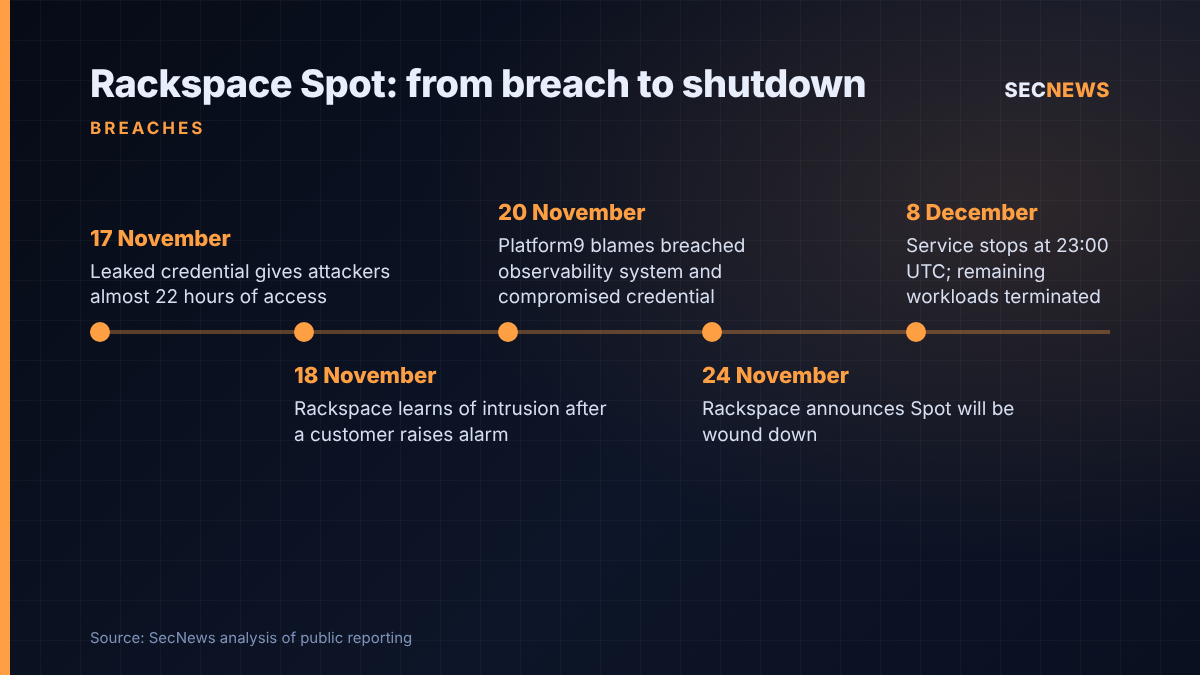
On 17 November 2026, attackers holding a leaked credential got into parts of Rackspace Spot and kept that access for close to 22 hours. Spot is the auction-priced Kubernetes service Rackspace built with Platform9, sold on the promise of very cheap compute for workloads that can tolerate being interrupted. According to a customer notification reported by The Register, Rackspace did not spot the intrusion itself. It found out on 18 November, after a customer raised the alarm.
While they were inside, the intruders posed as legitimate users, launched pods in customer clusters, pulled Kubernetes Secrets and enumerated nodes and volumes. Rackspace told customers the attackers “could have read any Secret in an affected user’s clusters”, along with any Spot API or refresh tokens those users held.
An extended outage followed. By 20 November, users on the project’s public GitHub discussion board were asking why the service had been dark for a full day. Sirish Raghuram of Platform9 answered there with a one-line explanation: “An observability system was breached using a compromised credential.” He added that the fix meant intrusive changes to the underlying infrastructure clusters, and he moved the restoration target back more than once.
Then, on Tuesday 24 November, Rackspace announced it was winding Spot down altogether. The service stops at 23:00 UTC on 8 December. Anything still running then will be terminated, and customers lose access to their data. Rackspace has not said how many customers were affected, why it chose closure over recovery, or whether it will extend the deadline.
The technical picture
From the public detail, this looks like a classic platform-layer compromise rather than a flaw in Kubernetes itself. A credential for a monitoring or observability system gave the attackers a foothold. That system plainly had enough reach into the control plane to let them act as tenant users, which is the part that should worry anyone who runs or buys a managed platform.
Once an attacker can act as a user inside a cluster, Kubernetes Secrets are the obvious prize. By default they are only base64-encoded objects in the cluster datastore, readable by anyone with the right role binding. In practice they hold the keys to everything else: database passwords, cloud provider keys, SaaS API tokens, registry credentials and TLS private keys. Creating pods matters too: a pod can mount secrets, run tooling or act as a persistence point.
Rackspace says it has killed the affected sessions and tokens, deleted the planted pods and replaced platform and storage keys. Its remediation advice to customers tells you how far the access went. Customers must reissue Spot API tokens, download fresh kubeconfig files and rotate every credential stored in their clusters. Spot’s own release notes for November also record that a network exposure on worker nodes was closed as part of security hardening. They do not link that change to the breach, so I would not draw a firm conclusion from it.
Why it matters for UK organisations
Spot is not a US-only curiosity. Rackspace opened a United Kingdom (London) region for the service in 2024, and its documentation lists uk-lon-1 among the regions offering its general-availability storage class. Cheap capacity attracts UK start-ups and development teams, and some will have put real workloads there.
For those customers there are two problems at once. The first is a breach response. Any secret held in an affected cluster should be treated as exposed, and if those secrets unlock systems holding personal data, UK GDPR comes into play. Controllers need to assess whether a reportable breach has occurred and whether the 72-hour clock to the ICO has started. The second is an enforced migration on a fortnight’s notice, with all the risk of rushed configuration, copied secrets and skipped controls that comes with it.
There is a wider lesson too. The UK’s Cyber Security and Resilience legislation is designed to bring more managed service providers into regulatory scope, precisely because a single provider-side compromise can cascade into many customer environments. Spot is a textbook illustration of that argument.
Expert view
When we test Kubernetes estates, the observability stack is one of the first places I look. Monitoring agents, log shippers and metrics collectors tend to be granted broad, cluster-wide read access because it makes dashboards work, and their credentials are often long-lived and stored in more places than anyone remembers. They are treated as plumbing, not privileged identities.
The detection gap is just as telling. Nearly a day of attacker activity, including creating workloads in customer clusters, went unnoticed by the provider until a customer flagged it. In my experience, that pattern usually means audit logging existed but nobody was alerting on unusual identity behaviour, such as a service credential suddenly acting as many different users.
Finally, the decision to shut the service down should give buyers pause. Shared responsibility models tend to assume the provider will be there to recover. Here, the provider decided recovery was not worth it, and customers inherited both the incident and the exit. Cheap platforms suit disposable workloads; trouble starts when disposable quietly becomes production.
What to do now
If you use Rackspace Spot, prioritise in this order:
- Assume every secret is compromised. Rotate database passwords, cloud keys, third-party API tokens, registry credentials and certificates held in any Spot cluster, at the source system, not just in Kubernetes.
- Reissue Spot tokens and kubeconfigs as Rackspace instructs, and revoke the old ones anywhere they were copied, including CI/CD pipelines and developer laptops.
- Hunt in downstream systems. Check logs for the services those secrets unlock for unexpected access from 17 November onwards, and look for unfamiliar pods or service accounts in your own cluster exports.
- Make a UK GDPR call. Record your assessment of whether personal data was put at risk and whether ICO notification is required.
- Migrate cleanly before 8 December. Rebuild in the new environment with freshly generated secrets rather than copying old ones across.
For everyone else running Kubernetes, the same incident is a useful audit prompt. Under Cyber Essentials, the user access control and secure configuration controls apply directly: review what your monitoring and observability tools can read, cut cluster-wide permissions back to what they actually need, and enforce multi-factor authentication on platform and administrator accounts. Move secrets into an external manager with short-lived credentials where you can, turn on encryption at rest for the cluster datastore, and alert on service accounts behaving out of pattern. Ask your managed providers how their own internal tooling is segregated from your tenancy, and what their exit plan looks like if they close a service.
Bottom line
A single compromised monitoring credential gave attackers a day inside a multi-tenant Kubernetes platform and ended with the platform being switched off. Spot customers should rotate everything now and migrate with fresh secrets. Everyone else should ask how much power their own observability tooling holds, because that is where this breach began.