A North Korea-linked operation called PolinRider is quietly rewriting genuine developers’ GitHub history to plant malware, with Apiiro counting at least 7,609 affected repositories. The newest wave hides a small Python loader that pytest can run automatically and steers itself through the Ethereum blockchain, so taking down its servers achieves very little.
What happened
Over the past week, three research teams have published findings that together show how far the PolinRider campaign has spread. Supply chain security firm SafeDep reported on 24 November 2026 that it had found a new Python loader in 375 public GitHub repositories belonging to 260 accounts. Two days later, The Hacker News reported Apiiro’s estimate that the campaign now touches at least 7,609 repositories owned by 2,330 accounts. Apiiro says the loader was pushed to 2,040 repositories between 27 October and 6 November.
What matters most is who the victims are. According to Apiiro researcher Shmulik Cohen, quoted by The Hacker News, around 86% of the affected repositories belong to personal accounts that are over a year old and show real activity. “These are real developers, not throwaway accounts,” he said. Named victims include Neutralinojs, InstaWP Connect and fxhash.
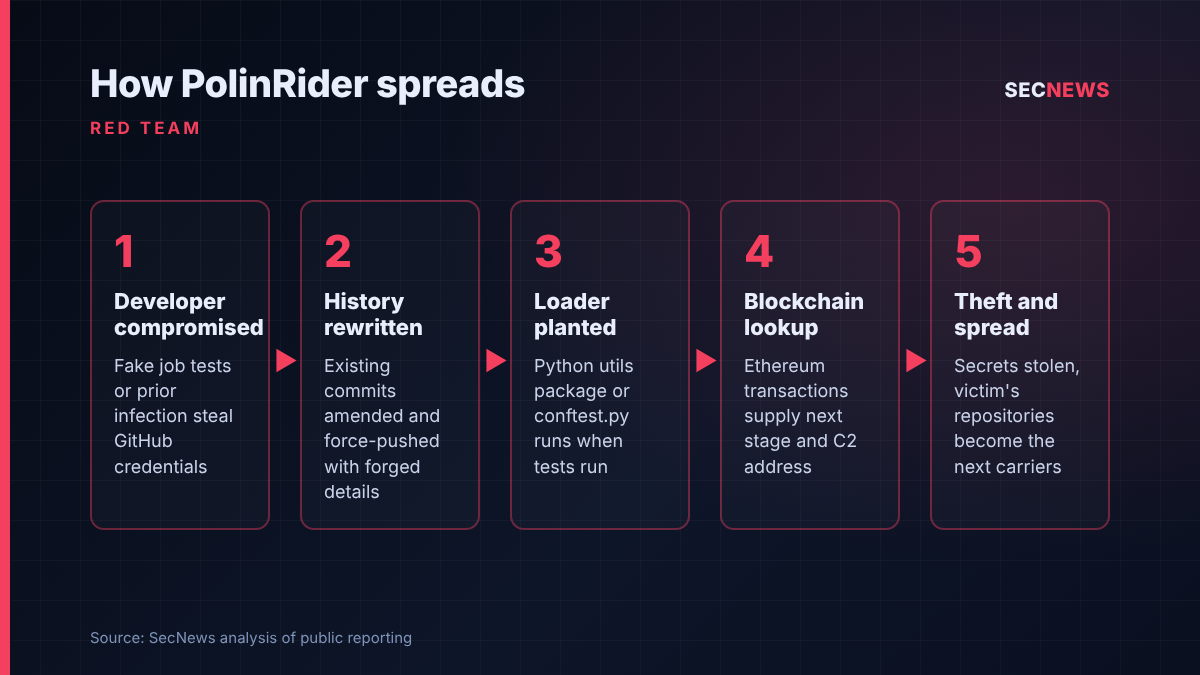
Researchers assess PolinRider as a North Korean sub-cluster running alongside the long-running Contagious Interview operation. Contagious Interview uses fake recruiters and take-home coding tests to compromise developers’ machines. PolinRider then uses the GitHub access stolen from those machines to turn the victims’ own projects into a distribution channel. OpenSourceMalware has also linked a May 2025 compromise of nine npm packages to the group.
The technical picture
The method is simple, and that is why it works. Once malware on a developer’s workstation has their GitHub credentials, the operators amend commits the developer has already made and force-push them back. The author, message and date stay the same, so a casual look at the history shows nothing unusual. SafeDep also found back-dated author and committer dates, including a commit dated September 2025 that relies on a wallet whose first transaction was in October 2026.
In the latest wave, the implant is a 58-line Python file that uses only the standard library, so dependency scanners have no unusual package to flag. It is given ordinary names such as session.py or transport.py and placed in a planted utils package, with import lines added to entry points such as a Django or FastAPI application file. It also appears in conftest.py, which pytest loads automatically, so simply running a project’s tests is enough to set it off.
Command and control (C2) is where the campaign shows real thought. The loader does not contain a server address. It looks up the latest transaction an attacker-controlled Ethereum wallet has sent to itself and treats the transaction data as the next stage. That stage reads a second wallet and decodes the C2 IP address from the recipient field of its most recent transaction. Researchers call this “NullReceiver”. SafeDep tracked the C2 moving through several IP addresses since September. Because the operators can repoint every infected copy with one cheap transaction, blocking an IP gives defenders only temporary relief.
No live copies of the final payloads have been captured. Earlier waves, however, installed stealers aimed at environment secrets, browser passwords, cookies, Git credentials and cryptocurrency wallets. Apiiro believes one of the current scripts is a remote-access tool that avoids CI runners and persists inside VS Code, Cursor, Discord and GitHub Desktop.
Why it matters for UK organisations
Most UK organisations will not think of themselves as targets of a North Korean operation. But this campaign does not need to target you directly. It only needs one of your developers, contractors or suppliers to clone a trusted-looking template, starter kit or library from GitHub and run its tests. SafeDep’s earlier research showed that many infected projects were exactly that kind of reusable scaffolding, with thousands of forks between them.
The prize is the developer workstation, which usually holds cloud keys in shell environments, package registry tokens, SSH keys and signed-in browser sessions for source control and cloud consoles. One compromised laptop can give an attacker a route into production infrastructure and, through the victim’s own GitHub access, into more repositories. For UK firms in scope of the Cyber Security and Resilience Bill, and for managed service providers in particular, this is a supply chain risk that ends up on the regulator’s desk.
There is also a reinfection problem. SafeDep found repositories that had removed an earlier infection but still carried the new loader in their latest commits. If you clean the repository but not the machine that pushes to it, the infection comes straight back.
Expert view
When we run red team engagements, the developer endpoint is often the softest route to the crown jewels, and PolinRider is a well-funded demonstration of why. Nothing here is technically novel on its own: credential theft, history rewriting and blockchain dead drops have each been seen before. The skill is in putting them together so that every trust signal a developer relies on, from a familiar author name to a sensible commit date, keeps looking normal.
In my experience, organisations treat “we only use reputable open-source projects” as a control. It is not one when the reputable project’s maintainer has been compromised. Equally, pinning dependencies does nothing about code you clone and execute directly. The most useful lesson is that a test run is code execution and should be treated as such, preferably inside a disposable container with no access to real credentials.
The blockchain C2 also changes the indicators that matter: wallet addresses outlive IP addresses, and Ethereum RPC calls from a developer laptop are worth hunting, even if they prove nothing alone.
What to do now
- Hunt for the loader. Search code you have cloned and your own repositories for the wallet addresses and indicators published by SafeDep, unexpected utils packages, and conftest.py files that write and execute temporary files. Check git history as well as the latest commit.
- Treat exposed machines as compromised. If anyone ran tests, builds or dev servers from an affected project, rotate every secret held on that machine: cloud keys, GitHub tokens, SSH keys, saved browser passwords and session cookies.
- Clean the pusher, not just the repo. Rebuild or fully investigate the workstations that push to an affected repository before you trust a fix.
- Isolate untrusted code. Run unfamiliar projects and recruitment “coding tests” in throwaway containers or virtual machines with no real credentials. This maps to Cyber Essentials secure configuration and malware protection.
- Tighten GitHub access. Use short-lived, fine-grained tokens, enforce MFA, require signed commits and branch protection that blocks force-pushes on important branches. This supports the Cyber Essentials user access control requirements.
- Monitor developer endpoints. Alert on Node.js or Python processes contacting public Ethereum RPC or block explorer services, and on detached Node processes with no terminal.
Bottom line
PolinRider turns ordinary developer trust into a delivery mechanism, and its blockchain-based C2 makes the usual takedown playbook almost useless. UK organisations should stop treating cloned code and test runs as harmless, assume any exposed developer machine is compromised, and lock down GitHub credentials before their own repositories become part of the next wave.