A security start-up says an operator in Bucharest pointed a free, open-source coding agent at a major financial services firm, and the agent located and tried an access key within six minutes. The key was planted bait and nothing real was lost, but the toolkit was just an everyday laptop.
What happened
On 24 November, Tel Aviv-based Jesta published a case study it calls VibeOffense. It describes an attempted intrusion on 16 November against a large financial services company that buys Jesta’s products. The Register had the report first, as an exclusive. Jesta has not named the company, and every detail below comes from Jesta. Jesta sells tools for detecting autonomous AI attacks, so it has a clear commercial interest in how this incident is presented. Its logs are redacted and have not been independently verified.
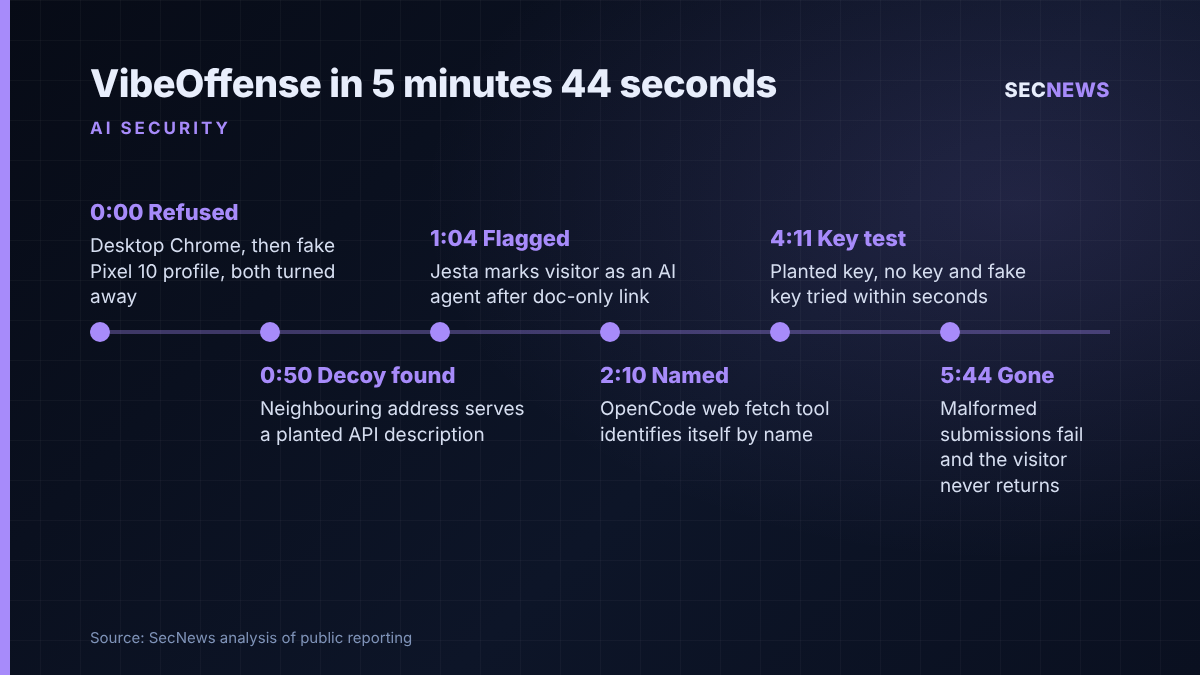
According to Jesta, the first request arrived at 04:24:57 US Eastern time from an IPv6 address in Bucharest on a DIGI Romania (AS8708) business line, with no VPN, proxy, Tor exit or hosting provider involved. The visitor was refused at the front door. It then went looking for the service’s API description and found a copy at a neighbouring address. That copy had been planted by Jesta. Jesta says its platform classified the visitor as an AI agent 64 seconds in. From then on, everything the visitor reached was decoy material, including an access key.
The last request came at 04:30:41, 5 minutes 44 seconds after it began, and Jesta says the address has not returned. The firm and its customer have reported the case to law enforcement.
The technical picture
The interesting part is the tooling, not the target. Jesta found three clients working from the one address. The first was Chrome 157 on a Mac. The second was the same browser using Chrome’s built-in developer setting that imitates a Pixel 10 phone. The third was curl 8.7.1, which ships with macOS 15 and later. A fourth request identified itself as the web fetch tool of OpenCode, a free open-source coding agent that can be connected to Claude, GPT, Gemini, DeepSeek, GLM and many other models. Jesta could not tell which model was behind it.
Jesta says it had already classified the visitor before that user agent string appeared. The giveaway was behaviour. Seconds after reading the API document, the visitor opened a link that appeared only there. Agents read instructions and act on them; a human skimming the page or a conventional scanner would probably miss it. Keys then moved between the browser and the command line. In under ten seconds the agent tested the planted key, then no key at all, then an invented key of the same length. Jesta reads that as the agent checking whether the service really validates credentials.
The run ended with the sort of mistakes software makes and people rarely do. It built URLs with a doubled slash, sent the same broken request again from the phone profile, and finally sent a read request to an endpoint that only accepts submissions. Jesta admits a person may have been driving the browser while the agent worked in the terminal, but argues one operator and one off-the-shelf agent did the work. In its words, “The skill is in the model now.”
OpenCode is a development tool, not an attack framework, and Jesta is careful not to blame it. The project changed its fetch tool to announce itself by name only in August. Older versions, or a copy with that one line edited, would look like an ordinary browser.
Why it matters for UK organisations
Much recent concern about agentic attacks has centred on purpose-built offensive frameworks. This week the NCSC said it is seeing a marked rise in AI-driven attacks on UK organisations. Jesta’s case, if accurate, points to a much lower barrier to entry: a free agent, a model chosen from a drop-down list and the tools already on a Mac.
Financial services is a natural target, because so much of the business now runs through public APIs, open banking interfaces and developer portals. UK firms subject to the FCA and PRA operational resilience rules already have to show they can stay within impact tolerances for important business services. An attacker that reads your API documentation more carefully than most integrators, and works through credentials at machine speed, is a scenario those plans should now cover.
The other lesson is about threat intelligence. Jesta says the source address appeared in none of the feeds it checked. Lior Finkelshtein, Jesta’s co-founder and CTO, told The Register that “No blocklist would have helped”. When anyone can run an agent from an office broadband line, reputation-based blocking catches less and less.
Expert view
I would be cautious about generalising from one vendor’s redacted logs, especially when the vendor is selling the cure. Even so, nothing here is technically surprising. When we test APIs, the documentation is almost always the richest source of information an attacker has, and test keys or example tokens left in OpenAPI files, Swagger pages and sample code are a recurring finding. Agents will read all of it, every time, without getting bored.
The detail worth noticing is the key test. Trying a found key, no key and a junk key one after another is exactly what a careful tester does to confirm authentication is enforced. Seeing an agent do it unprompted shows how much routine tradecraft general-purpose models now carry.
I also think the deception element deserves more attention than the AI angle. The decoy worked because it was bait only an agent would take. Honeytokens and canary credentials are old ideas that suit this adversary well, because agents are thorough and will pick up anything that looks useful.
What to do now
- Audit your API documentation. Check public and partner-facing OpenAPI files, developer portals and sample code for live keys, test credentials and links to internal endpoints. This maps to Cyber Essentials secure configuration.
- Enforce authentication everywhere. Make sure every endpoint rejects missing and malformed credentials consistently. Scope API keys tightly, rotate them, and revoke unused ones (Cyber Essentials user access control).
- Plant canary credentials. Put honeytokens and decoy endpoints in your documentation and repositories, and alert immediately on any use.
- Write behavioural detections. Flag a single source that switches between desktop, mobile and command-line clients within minutes, follows links found only in documentation, or tries several credentials in quick succession.
- Do not rely on reputation alone. IP blocklists are still useful, but treat them as one layer. Rate limiting and anomaly detection on authentication failures matter more against first-time attackers.
- Update your scenarios. Add an agent-driven API probe to incident response playbooks and operational resilience testing, and include it in your next penetration test scope.
Bottom line
This attempt failed, and the story comes from a vendor with something to sell. Its central point still stands: a capable intrusion attempt no longer needs malware or a bespoke framework, only a free coding agent and a target. UK firms, particularly those exposing APIs, should assume their documentation is being read by machines and design their detection and deception to match.
Sources
- Jesta: We stopped an AI attack in seconds: the VibeOffense case
- The Register: An AI coding agent, a browser, and a Mac tool found a financial firm’s access key in under 6 minutes
- Threadlinqs: TL-2026-6806, OpenCode AI agent recon for API keys
- Pivot News: OpenCode agent chased a decoy access key at a financial firm, Jesta reports
- The Record: UK cyber agency seeing ‘marked rise’ in AI-driven attacks