Arion Kurtaj, the Oxfordshire member of Lapsus$ who hacked BT/EE, Revolut, Uber and Rockstar Games, has been given seven years and walked free on licence the same day. For defenders, the useful material is in what the prosecution said about how he got in and kept going.
What happened
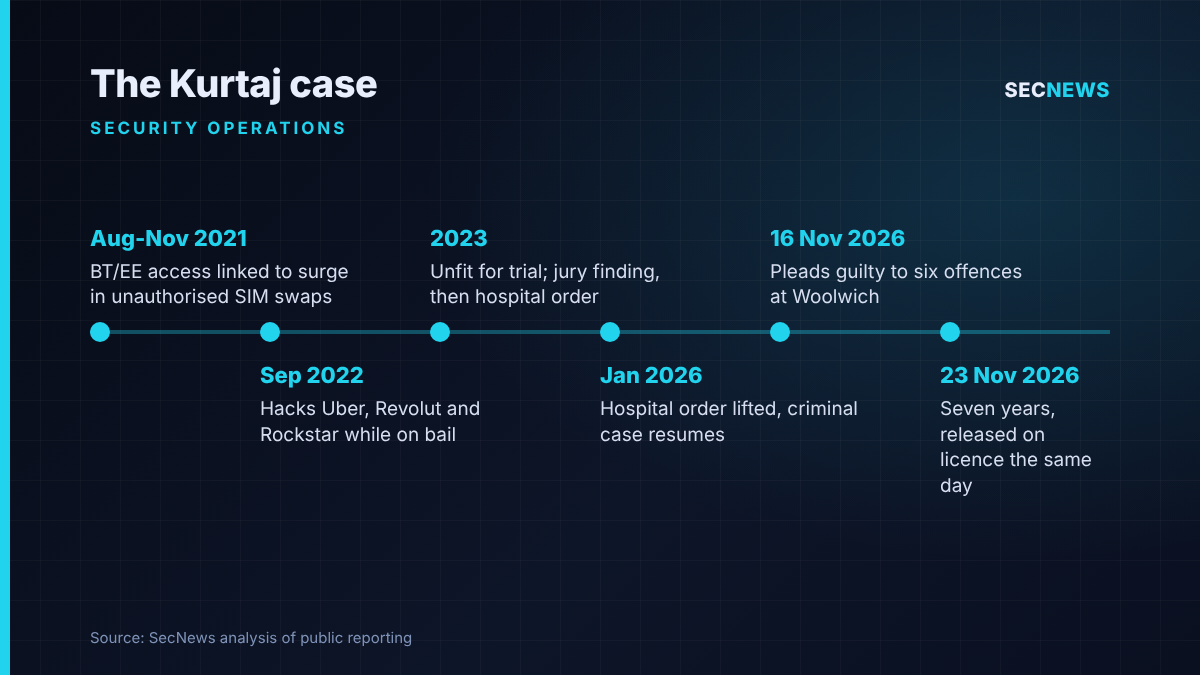
On Monday 23 November 2026, Woolwich Crown Court sentenced Kurtaj, now 21, to seven years’ imprisonment. The court began from a nine-year term and took two years off to reflect the period he had already spent detained under a hospital order. City of London Police confirmed that he was then released on licence, so the remainder of the term will be served on supervised release, with recall possible if he breaks its conditions.
A week earlier, on 16 November, Kurtaj had pleaded guilty to six offences: four under the Computer Misuse Act 1990, one count of fraud under the Fraud Act 2006 and a Prisons Act 1952 offence for having a phone in custody. Seven other charges will lie on file. According to the Crown Prosecution Service, the offending ran from August 2020 to September 2022 and hit telecoms firms, a computer parts maker, gaming companies, a transport business and an online bank.
Kurtaj was arrested and remanded in September 2022, then judged unfit to stand trial. In 2023 a jury found that he had committed the acts and he was placed under a hospital order. That order was lifted in January 2026, which allowed the criminal case to resume. On remand he was found with a phone; the CPS says he used it in March 2026 to send a taunting 999 message.
City of London Police, working with Thames Valley Police, says it will now apply for a Serious Crime Prevention Order. The BBC, as cited by The Record, reported that a five-year order already bars him from Telegram and Discord; the police statement itself only refers to seeking an order.
The technical picture
The prosecution case shows what a Lapsus$-style intrusion costs its victims:
- BT/EE (August to November 2021): the CPS says Kurtaj gained remote access to the operator’s servers and to programming interfaces, and that this access was behind a sharp rise in unauthorised SIM swaps on customer numbers in early November 2021. A SIM swap moves a victim’s number to an attacker-controlled card, which hands over calls, texts and any one-time codes sent by SMS.
- Revolut (2022): prosecutors say data on thousands of customers was compromised.
- Uber (2022): data was stolen and deleted, accounts were removed from internal systems and a lewd image was pushed to staff. The CPS put the cost above $2.8 million.
- Rockstar Games (2022): 90 development clips of Grand Theft Auto VI were taken and posted under the handle TeaPotUberHacker, with a threat to leak the source code as leverage for blackmail.
The most striking detail is the setting. In September 2022 Kurtaj was on bail, his computer had been seized, and he had been put up in a hotel for his own safety. He carried on anyway, using a phone, the hotel’s Wi-Fi and an Amazon Fire Stick connected to the room’s television. Investigators later tied his aliases to him through device analysis that built timelines of places and dates.
Why it matters for UK organisations
Two of the four named victims are household names in UK telecoms and finance, and the BT/EE thread matters well beyond one operator. Every UK business that still relies on SMS codes for staff or customer authentication is implicitly trusting the mobile network’s controls on number porting and SIM replacement. Once an attacker can manipulate those controls, the code arrives on their device and your login page cannot tell the difference.
The bail episode makes a second point. Seizing a suspect’s laptop did not stop the activity, because the attack needed nothing more than consumer hardware and a network connection. That is the defining feature of this kind of crew: the skill lies in persuading people and abusing legitimate access paths, not in custom tooling. Arrests and sentences are welcome, but they do not lower the risk for defenders, because the playbook needs no rare skills and anyone can pick it up.
City of London Police also thanked the victim companies, saying their cooperation with investigators may have spared other organisations. Incident responders should preserve evidence that will stand up in court, not just restore service.
Expert view
When we run social engineering and identity-focused tests, the weakest point is rarely the firewall. It is the process around an identity: who can reset a password, who can enrol a new MFA device, who can approve a SIM change, and what evidence they ask for before doing it. Lapsus$ showed that a determined teenager with a phone can exploit exactly those seams, and the damage here came from internal interfaces and admin functions, not anything exotic.
In my experience, many SOCs are tuned to look for malware and odd processes on endpoints. Intrusions like these generate a different signal: a legitimate account behaving in a way its owner never would, a burst of help desk changes, an API used at an unusual volume, or a sudden wave of account deletions. If your detection content does not cover identity and SaaS audit logs as seriously as EDR alerts, you will see this kind of attack late, probably when the attacker announces it on Telegram.
The same-day release reflects time already spent detained, not leniency, and the prevention order is the more interesting control. For defenders, though, nothing in this outcome changes the threat model.
What to do now
- Retire SMS as a second factor for privileged and remote access. Move admins, help desk staff and anyone with access to customer data to phishing-resistant MFA such as FIDO2 keys or passkeys. This supports the Cyber Essentials user access control requirements.
- Harden the help desk. Require out-of-band verification through a known number or manager approval before password resets, MFA re-enrolment or changes to privileged accounts, and log every such action.
- Alert on identity changes. Build SOC detections for new MFA methods, rapid admin role assignments, bulk deletions and unusual API volumes in Entra ID, Okta, Google Workspace and core SaaS platforms.
- Restrict and monitor internal APIs and admin consoles. Put them behind strong authentication, limit who can reach them, and rate-limit sensitive functions such as SIM or account changes.
- Plan for extortion and public leaks. Include a scenario in your incident response exercises where the attacker posts stolen material and messages staff directly.
- Preserve evidence and engage early. Keep logs long enough to support a prosecution, and report to Action Fraud or the NCSC so that law enforcement can connect your incident to others.
Bottom line
Kurtaj’s sentencing ends one of the UK’s most prominent cyber crime cases, but the techniques he used remain in daily circulation. The lesson for UK SOCs is to treat identity systems, help desks and internal interfaces as primary attack surfaces, and to make sure that a convincing phone call or a swapped SIM is not enough to open the door.
Sources
- City of London Police: Man who committed cyber attacks on gaming companies and telecoms industry sentenced
- Crown Prosecution Service: Lapsus$ hacker who leaked GTA VI gameplay videos convicted
- The Record: ‘Grand Theft Auto VI’ hacker sentenced to seven years, released the same day
- Help Net Security: GTA 6 hacker sentenced to seven years and released the same day
- IBTimes UK: GTA 6 hacker Arion Kurtaj walks free despite seven-year jail sentence