Google Project Zero has published the full technical account of how one changed header bit let untrusted .NET code get past Windows application control and VirtualBox’s process hardening. Two routes are now patched, but by the researcher’s own account the route into Protected Process Light still works.
What happened
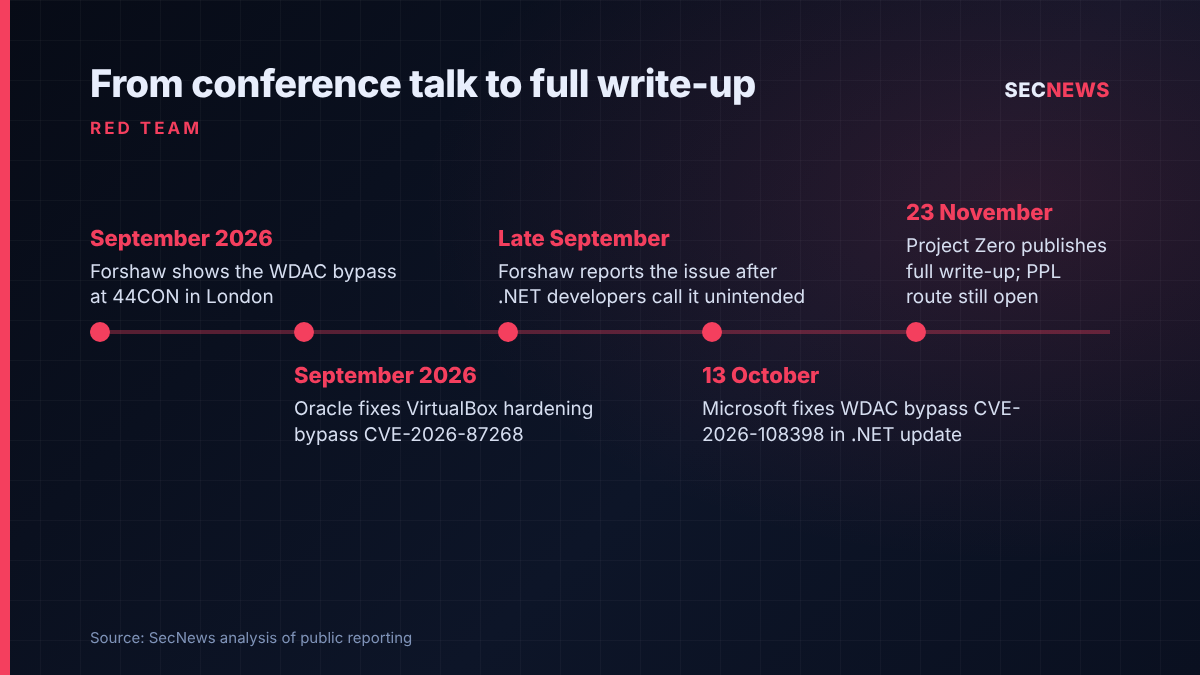
On 23 November 2026, James Forshaw of Google Project Zero published a detailed write-up of research he first showed at 44CON in London in September. Most defenders had previously known it only as a line in October’s Patch Tuesday notes.
The research covers three outcomes from one root cause. The first, CVE-2026-87268 (CVSS 7.8), defeats the self-protection VirtualBox applies to its own processes when running on Windows. The second is a bypass of Windows User Mode Code Integrity, the enforcement layer behind Windows Defender Application Control (WDAC), tracked as CVE-2026-108398 (CVSS 8.8). The third is code execution inside a Protected Process Light (PPL) process by a user with no administrator rights. That route has no CVE.
Oracle fixed the VirtualBox issue in September; The Hacker News gives 7.2.18 as the fixed build. Microsoft fixed the WDAC route in the .NET Framework cumulative update of 13 October and lists it as publicly disclosed but not exploited. What is new this week is the detail, the VirtualBox fix explained in full, and Forshaw’s assessment that Microsoft’s change leaves protected-process loading untouched. On his reading, the PPL route should still work.
The technical picture
The root cause sits in how the .NET Framework 4 runtime loads assemblies. It normally asks Windows to map a file as an executable image, which is where code integrity and products such as VirtualBox apply their checks. If the image mapping fails with a particular “bad format” error, the runtime does not give up. It falls back to reading the file as plain data and laying it out in memory itself. That fallback path skips the image-level checks, yet the runtime will still execute the managed code it contains.
In VirtualBox, the hardening code that screens image loads returned exactly the error that triggers this fallback when it met an “AnyCPU” .NET assembly on a 64-bit host. An unmodified assembly therefore slipped through a path the hardening never inspected. Forshaw delivered it with COM hijacking in the current user’s registry hive, so a protected VirtualBox process loaded attacker-chosen .NET code when a virtual machine started. This is not a guest-to-host escape; it starts from an ordinary local account on the host.
For Windows application control, the trick needed one more step. Flipping a single flag in the file header makes Windows refuse to map the file as an image, which sends .NET down the flat-load path. A separate policy check in the runtime should have stopped this, but it tested for a configuration that Windows 11 S Mode happens to report, so the check passed. Forshaw demonstrated an untrusted assembly running on S Mode with UMCI enforced. In his words, “This single bit change is all you need to load an untrusted .NET assembly.”
The protected-process angle follows from the same flaw. The .NET loader does not consider whether the hosting process is protected. Full Protected Processes demand page hashes in signatures, which .NET DLLs lack, so only PPL is exposed. By hijacking a COM object loaded by the Windows Error Reporting component WerSecureFault.exe, Forshaw ran code inside a PPL process at a high signing level without administrator rights.
There is also a disclosure story here. Forshaw first judged the WDAC issue to be outside Microsoft’s servicing criteria and presented it publicly instead. Only after .NET developers said the behaviour was unintended did he report it, in late September. Because it was already public, Microsoft treated it as a zero-day and shipped a fix in under a month.
Why it matters for UK organisations
Application control has become a core control for UK organisations working towards the NCSC’s Cyber Assessment Framework, and WDAC is the native way to do it on Windows. Many public sector and regulated estates treat an enforced allow-list as the backstop that stops a phished user from running a dropped payload. This research shows the backstop had a gap in the managed-code loader.
PPL matters for a different reason. Microsoft uses it to protect LSASS and to shield anti-malware services from tampering. A user-level route into a PPL process is the sort of primitive red teams prize and that defenders assume is closed. It is a local technique and needs an existing foothold, so it is not a mass-exploitation threat. But it fits neatly into a post-compromise chain.
VirtualBox is less common on managed corporate desktops, but it is widespread on developer, lab and training machines, which are often less tightly controlled than the main estate.
Expert view
When we test hardened Windows builds, the conversation with the client usually ends at “the allow-list will stop it”. This research is a good reminder that application control is a set of checks at particular choke points, not a property of the whole machine. If a runtime has a quiet fallback that sidesteps the choke point, the policy never gets a vote.
The PPL detail is what I would put in front of a security architect. Until Microsoft says otherwise, assume a capable attacker with a user-level foothold may be able to run code inside a PPL process. Any design that leans on PPL alone to protect credentials or security tooling deserves a second look.
The disclosure point matters too. Forshaw suggests that ambiguity in Microsoft’s servicing criteria can leave real weaknesses unreported. In my experience, defence-in-depth bypasses are often filed as “by design” and then turn up in someone’s tooling. Red teams should test for them rather than wait for a CVE.
What to do now
- Confirm the October .NET Framework update is installed everywhere. Microsoft’s release notes list the correct KB for each Windows and .NET Framework combination. This maps to Cyber Essentials security update management.
- Update VirtualBox on Windows hosts. Confirm the running binary is a fixed release. Remove it from machines with no business need for it.
- Tighten COM hijack detection. Both routes rely on per-user COM registrations. Alert on new or changed CLSID entries under user hives, particularly ones pointing at .NET assemblies or at objects loaded by protected processes.
- Do not rely on PPL alone. For LSASS, add Credential Guard where hardware allows, plus monitoring for unusual loads and handle access around protected processes and security agents.
- Layer your application control. Keep WDAC enforced, but pair it with attack surface reduction rules, least privilege (the Cyber Essentials user access control requirement) and EDR telemetry on managed code loaded from unexpected paths.
- Ask your red team to test it. Include managed-code loading and COM hijacking in the next assumed-breach exercise against your WDAC policy.
Bottom line
The October patch closed the WDAC hole, but the full Project Zero write-up shows how thin the line was. A one-bit change and a fallback loader were enough to defeat two well-regarded protections. The open PPL route is the reason to treat protected processes as one layer of defence, not the last one.
Sources
- Google Project Zero: VirtualBox Process Hardening on Windows 2026 Edition: What’s a Single Bit Between Friends?
- The Hacker News: Google Researcher Shows How a Single Bit Change in .NET Files Bypassed Windows Code Integrity
- Computing.net: Google Researcher Says One Bit Change Let Code Slip Past Windows Protections
- Microsoft Learn: .NET Framework October 2026 cumulative update release notes